
In the last episode of Dragon Ball Z, we broke down the first three emails of our outbound sequence.
What most people don't realize is that Gong Data shows that mixing in cold calls and social selling will 2-3x your email reply rate… even if you don’t book meetings on those other channels.
So today we're going to break down how to book meetings on the phone and LinkedIn (or still get an email reply even if they never answer on one of those channels:
- The Structure (How Calls + LinkedIn Weave Into The Sequence)
- The Cold Call Script
- The Voicemail Script
- The LinkedIn DMs
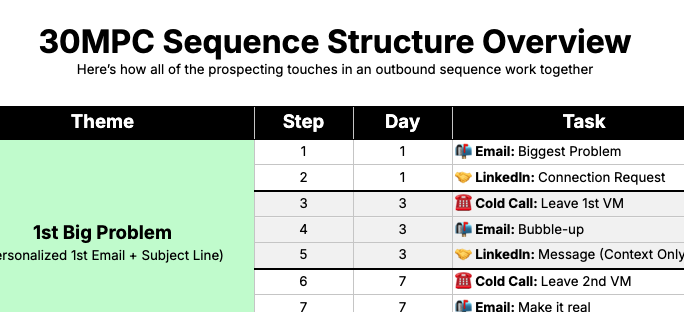
Now before we dive in, let’s orient around where these touchpoints fall in the sequence.
The Structure (How Calls + LI Weave Into The Sequence)
The key is to get all of your touch points working in a symphony together.
- Your emails give them a place to reply
- Your cold calls give them a place to hear your voice
- Your LinkedIn DMs give them a way to see your face
Here’s how that all looks inside of our sequence:
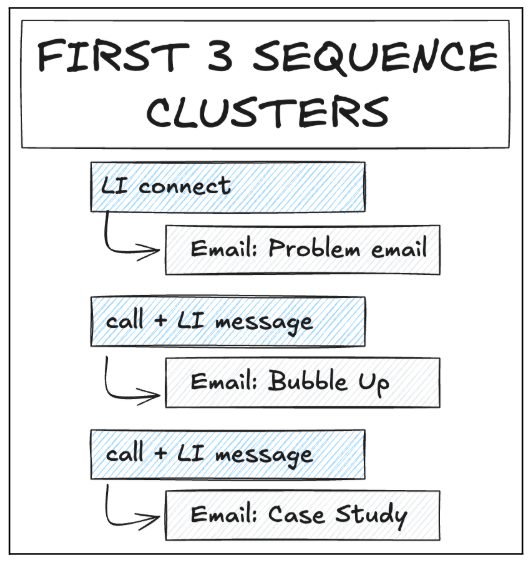
- Cluster 1 (LI + Email): You lead with a LinkedIn connection to improve your email reply rate. You don’t cold call yet because email is fast and will reveal a lot of bad contact data, quick no’s, or people who’ve left the company.
- Cluster 2 (Call + LI + Email): A few days later, you cold call them, leave a voicemail, send the first LinkedIn DM.
- Cluster 3 (Call + LI + Email): A few days later, you cold call them, leave a 2nd (and last) voicemail, send the 2nd (and last) LinkedIn DM.
The key with all of these touch points is to
A. Reuse the personalization from your first email so you don’t have to do research again
B. Use voicemail and LinkedIn to drive back to the email so you don't have to keep pitching on every single channel.
Let’s start with the call script.
The Cold Call Script
If you could recall from the last newsletter, the main personalization trigger we use in our cold email is the fact that their team already has a bunch of 30MPC superfans.
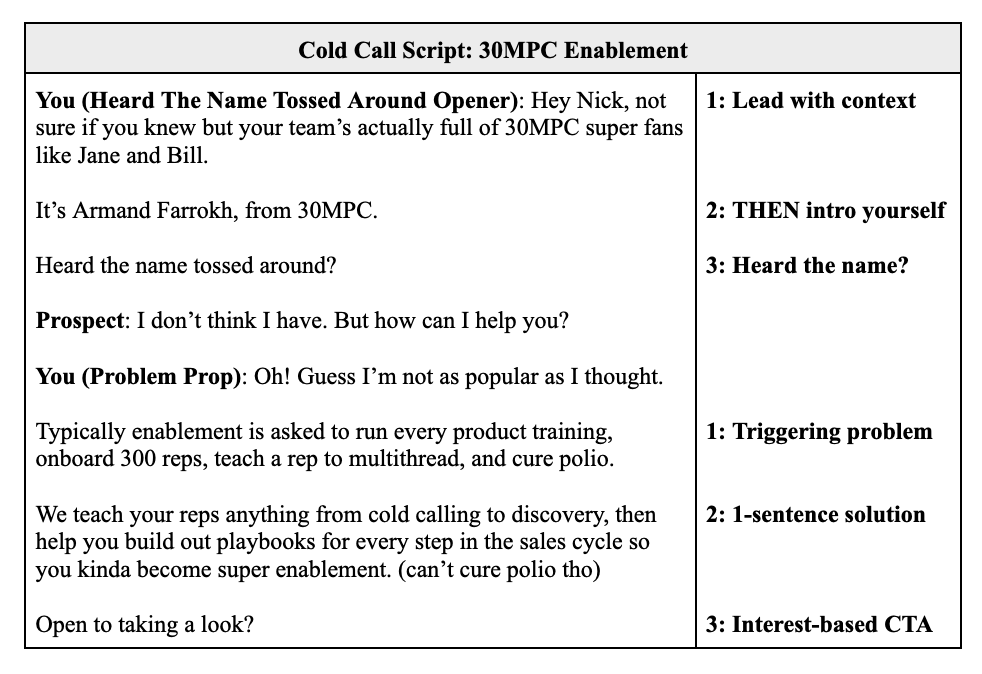
So this is what our cold call script looks like:
This isn't a cold calling newsletter, so I won't break down everything related to our cold call script (which we’ve covered in our book, courses, and in this free script).
But the major components are:
- Lead with context in your opener (instead of did I catch you at a bad time or how’s your day going)
- Then the triggering problem created by the context you cited (which is what they care about)
- Then the one-sentence solution aka how you solve the problem (that’s what you care about)
- Then an interest-based CTA instead of asking for a heavy meeting
Sound like the cold email framework? YEAH.
Good outreach starts with something about them and then builds a bridge to something about you. It doesn’t lead with your solution.
The Voicemail Script
If they don’t answer, your goal is NOT to get a call back. It’s to get an EMAIL reply.
Gong Data shows that voicemails that are really triple your cold email reply rate, but they almost never lead to a call back.
For this reason, we are going to withhold the pitch and instead only lead with context about them to pique their interest… then direct them back to the email. The moment they see a pitch in your voicemail, they are going to block your phone number. Let the email do that work.
Here’s our voicemail script.

Two pro tips:
- Incentivize the reply by telling them you're going to call back (aka reply if you don’t want a call back!)
- Move your intro to the end because leading with your name and company will get an instant voicemail rejection (they only need your name to identify your email).
The LinkedIn Touches
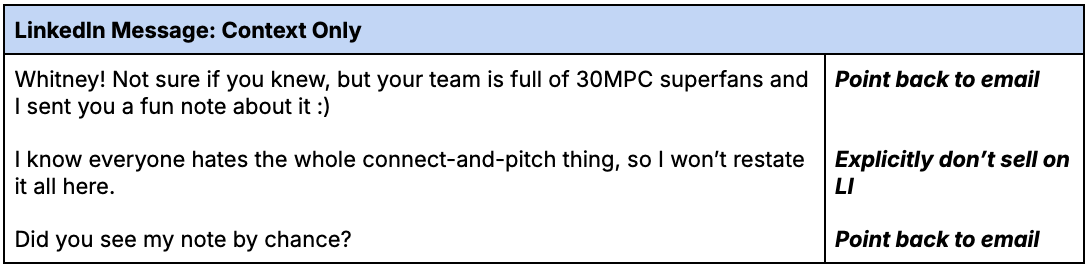
You're going to use the exact same logic that we applied to voicemails to LinkedIn touchpoints because there's nothing that people hate more than a connect and pitch.
The key benefit of LinkedIn is that it allows you to put a real face to your name and draw attention back to the email.
Our LinkedIn touches are as follows:
1: Send a blank connection request: Most people accept blank requests so don’t waste time personalizing yours. Connection messages can trigger “sales alarms” and often decrease the chances of an acceptance.
2: Send a context-only first message: Send a DM if they accepted with context only. Use an InMail it's a tier one prospect, but otherwise save it.
3: Send a thoughts bubble-up: Yep, it’s just like the 2nd email.

4: (Optional) Send a test drive bubble-up: Yep, it’s just like the 3rd email. Except instead of a case study, we are sending an example of harbor tour demo (a test drive bump).

***
And that's a wrap folks! Two things for you.
A: We can help your team book more meetings and build your outbound playbooks 30mpc-style.
B: Get the full outbound sequence below.
Go book some meetings y’all.