
Most sales onboarding programs are a waste of time. Locking sellers in a classroom miles away from prospects and force-feeding them academia doesn’t exactly inspire a hot start to a new job.
Today, we’re breaking down how to build a phenomenal sales onboarding program in 3 sections:
- Key Principles of a Great Onboarding Program
- An Example 4-Week Onboarding Plan
- After Onboarding, How to Ramp Your Reps Forever
Let’s dive in.
Key Principles of Great Onboarding
Let’s start with the key ingredients for onboarding so you can incorporate them into your own plan.
Principle #1: Train in this order: industry → product → sales
- Industry: What’s day-to-day like for my prospects and what problems do they struggle with?
- Product: How does our product solve those problems?
- Sales: How do we attach problems to solutions in a sales conversation?
In times of high stress, like a first discovery call at a new job, reps often fall back on what they first learned. It’s far more important to understand the prospect’s world and common problems you solve than it is to set a perfectly eloquent upfront contract.
Principle #2: Pair learning with doing.
Every classroom session should be paired with a corresponding “doing” session:
- Territory Planning & ICP Review → Rep tiers the accounts in their territory
- Demo Training → Practice your demo flow with onboarding buddy
- Prospecting Training → Write 5 emails for real prospects
Having reps take immediate action on what they just learned makes it stickier because they have to use the learning in the context of doing the job. This also gets them ahead of plan by building pipeline even during ramp period.
Principle #3: Get them in the game quickly AND safely
Pairing learning and doing will get sellers moving quickly, but if you just tell a new rep to prospect 25 accounts, you’ll end up with a boatload of:
- Crappy emails
- Sent to the WRONG contacts
- On accounts that will never buy
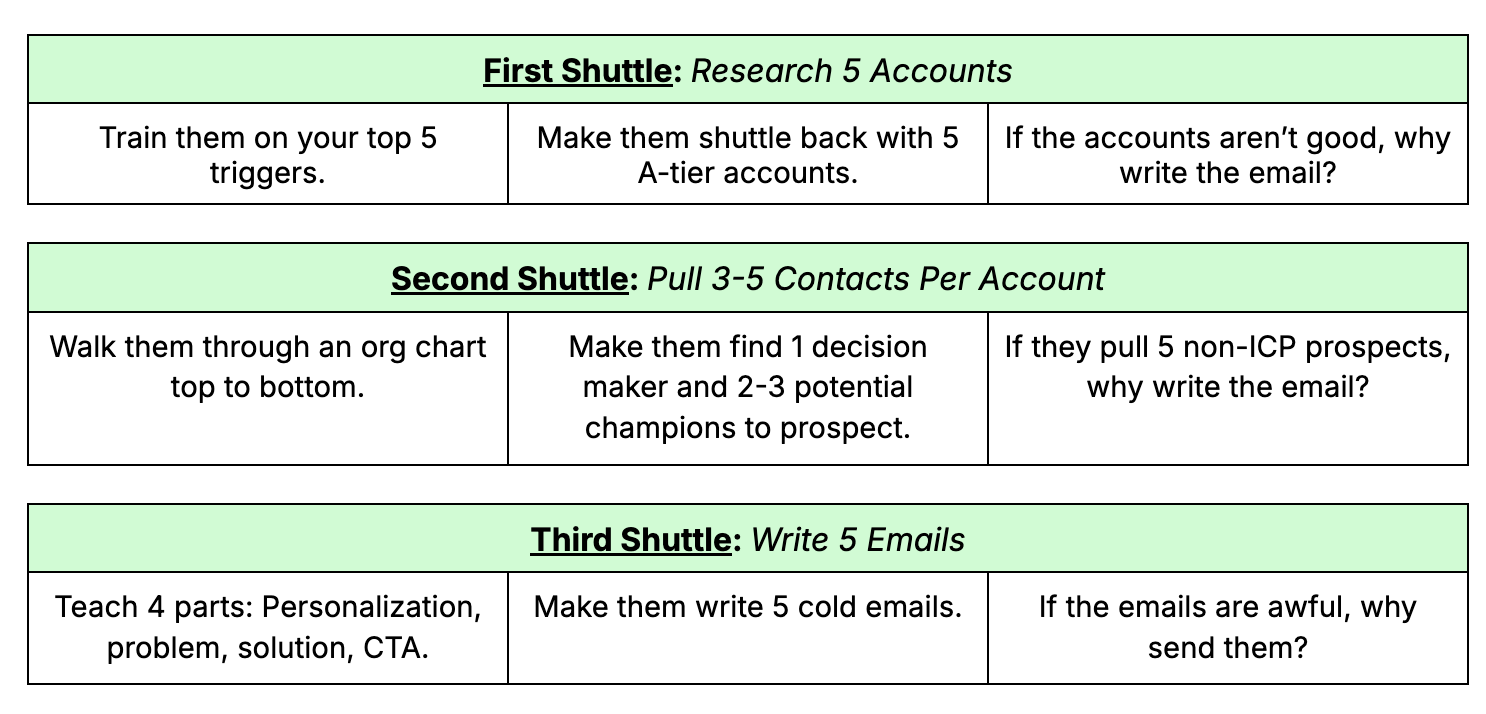
Use “shuttle runs” to break core parts of the job into smaller steps. Then have your reps shuttle back to you between each step so you can ensure they’re on the right track.
For cold email, that looks like:
Now that you know the principles, let’s look at how they get integrated into a sample onboarding plan.
Sample Onboarding Plan
This plan is how Armand Farrokh onboarded his reps as VP of Sales at Pave. We walked through this plan in-depth in this video, so I’ll just summarize things below. If you want to use our onboarding template, get it here.

You want to start off the week with a bang but in order to make sure your reps are ramped and ready to go you gotta get the company nonsense out of the way first (HR set up, laptop set up, benefits stipends, etc). Nobody is getting much done on that first day anyway.
Every day of each week, you want the first half of the day to be “classroom” style learning sessions with the second half being the actual “doing” sessions.
By end of week 1, reps should be able to (intelligibly) start prospecting. It won’t be perfect, but you have to break the seal of prospecting reluctance fast.
This means they’ll need:
- Systems Setup (Thrilling, I know)
- Minimum viable industry, product and sales training
- Their book of accounts
Keep in mind the shuttle run principle from above so they don’t get too far off course when prospecting.

50% of their time in week 2 should be spent doing. Use mornings for training sessions when they’re fresh, but afternoons should be spent prospecting and running 2-3 mock discovery calls per day.
Give them a list of people on the team to do mocks with and make your reps take ownership of setting them up. This also starts to get them culturally integrated and engaging with the broader team.
Your goals for week 2:
- Reps book their first outbound meetings.
- Level 1 Discovery Proficiency: they can set an agenda, uncover a problem and set next steps.

80% of their time should be spent doing by week 3. That includes taking real sales calls with SMB and DQ accounts.
Use the other 20% of time either training them on 201 level topics OR coaching them on their actual sales calls. If you’re onboarding a cohort of reps, you’ll want to run group tape reviews.

100% of their time is spent doing the job. Sales calls should be supervised by their manager or a seasoned rep.
That doesn’t mean the training stops at week 4. In fact, the training never really stops. After onboarding, use 20-80 Training Rhythms (Explicitly NOT 80-20) to build a team of President's Club Reps.
Use 20-80 Training Rhythms to Ramp Your Reps Forever
-1.png)
Most leaders know they should be training their reps, but when the trainings always seem to go in one ear and out the other, why even bother?
The problem is that most trainings are structured backwards: 80% of the time on upfront training and only 20% on reinforcement. 30 days later, no one remembers any of the 8 things you trained on in the last month. Shocker.
Instead:
- Every Month: Run one sales training in visceral detail (the 20%). The exact words to say on a cold call. The 7 questions you can ask to get a painful story on a discovery call. The reps need to know exactly what to say, why to say it, and how to say it.
- Every Week: Maniacally reinforce it in your training rhythms (the 80%). New cold call opener? 4 call reviews. New multithreading process? 4 deal reviews. New discovery questions? 4 tape teardowns. Over and over and over again.
- Every Day: Let small problems burn so you can focus on the big ones. Trying to train your reps on everything all at once means they will remember nothing.
- Right Now: If you like the sound of this training approach, check out how 30MPC can help your sales team with this ;)
Most leaders overestimate what they can accomplish in a week and underestimate what they can accomplish in a year. If you pick ONE thing every month… your team will be massively leveled up in 12 domains of sales every single year and that’s way more than any other team out there can say.
***
Woo hoo! YOU are officially onboarded on how to onboard a rep!