

I want you to remember the first time you opened a CRM and a sales engagement platform.
You probably felt like an old man opening Windows 95 for the first time.
- How the hell do I “move” these people from a CRM to a sequence?
- How do I know when the sequence is done?
- WHY ARE THERE 7 TOOLS TO REACH OUT TO ONE PROSPECT?
- I AM GOING TO DO THIS ON A SPREADSHEET INSTEAD.
This is the same old man confusion most reps bring to their prospects during a demo.
Remember: You live in your software all day.
But your prospect is seeing it for the first time.
A prospect must be able to envision their daily life INSIDE of your product in order for it to click.
So here today I’m gonna cover the 3 things we do to make our demos “real” for prospects (along with the mistakes I see with most demos today):
- Orient your prospect with a 3 Part Pitch
- Map the “realizations” instead of the products
- Demo the day in the life instead of feature-speak
We’ve been working a lot on this at 30MPC as we sell our enablement program to sales teams, so I’m going to use that as the main example (but I’ll pull in other examples from companies I’ve advised in the past).
1: Orient your prospect with a 3 Part Pitch
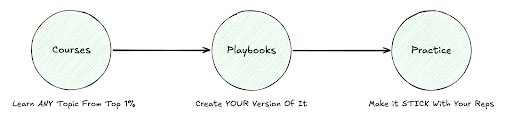
Every single demo I ran at Pave (and now at 30MPC) begins with these 3 dots.
Why? I have no idea wth most sellers do when they try to explain their product to me.
Most pitches sound something like:
“We’re an AI agent platform that helps revenue organizations streamline their forecasting processes and mitigate deal risks”
Throw bizarre product categories (agent platform) and buzzwords (streamline) in the trash.
If you want your prospect to understand what the heck your product does:
- Break it into 3 steps
- Put it in chronological order
- Explain it in “dumb human language” without any buzzwords
After discovery, we pull up the 3 dots above and simply explain:
The 30MPC enablement program helps your reps learn any skill from cold calling to multithreading in three steps:
- Our courses will literally teach your reps any topic in sales from the top 1% of sellers. Problem is, most trainings aren’t tailored to your company…
- So we’ll partner with you to build custom playbooks that work for your company whether it’s your own cold call script or discovery flow. Problem is, most trainings go in one ear out the other.
- So we’ll help you facilitate practice workshops so your reps master this forever whether that’s a cold call roleplay or a discovery call teardown.
(Pro Tip: I like to use “problem is” language to transition between products)
The general formula is “we use [PRODUCT] to help you achieve [OUTCOME].
Notice that we only use the product is to explain ✅what they will achieve with minimal focus on ❌what the product does.
2: Map the “realizations” instead of the products
From here, we drop into our demo flow.
It’s critical that the steps in your DEMO mirror the steps in their DAY.
Most demo flows are massively disorienting because they jump into the middle of the product instead of dosing the complexity of it all bit by bit.
The easiest fix is to document what you want them to realize… THEN what you want to show. The first few steps in our demo flow look like this:

This accomplishes two things:
- This forces us to only demo things that are relevant to solving the problem. If you can’t explain what you want them to realize, you’re demoing solutions in search of a problem.
- This forces us to demo things in the right order. If the “realizations” don’t read like a story or jump all over the place, the prospect will probably be massively confused.
You need to dose product to your prospect. Layer in the complexity inch-by-inch.
3: Demo the day in the life instead of feature-speak
Now it’s time to demo a specific part of your product.
We wrote about this a lot in our book on cold calling: Your prospect does not care about your product, they only cares about the problem it solves.
Before you talk about your product, talk about the problem in the day of their life.
A bad demo focuses on what the product is literally doing:
❌Here you can access the course module on objections as well as cold call scripts for all of the objections covered.
A good demo focuses on what they’re achieving (and the product is an afterthought):
✅You mentioned your SDR team was really struggling with your competitor ConvertCo. So your reps are gonna learn exactly how to handle any competitor in 3 steps in module 9, then we’ll literally build a script to takedown ConvertCo together next time they pickup the phone.
It sounds obvious, but listen to one of your calls.
Notice how often you might be focusing on what your product is doing instead of what your prospect is experiencing.
---
And that’s a wrap folks! We’re gonna tackle a demo course at some point, so…
Feel free to reply and lmk what you liked/didn’t like (or anything else you wanna see us cover related to demos).
And a shameless plug: if you want 30MPC to train your sales team after reading this noozy, check out our enablement program right here ;)