

1. Pretend the quarter ends a week early
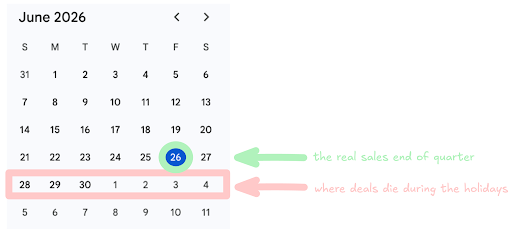
Yes, the quarter technically ends June 30th. But as you’re probably experiencing right now, most prospects are already checked out.
If they’re not hanging at the beach or on vacation, they’re almost certainly mentally already on their second cheeseburger at a family barbeque. Nobody is thinking about signing contracts when July 4th is right around the corner.
When you set signature date commitments, use the week before EOQ as your “sign date”. Treat the last week of the quarter as a dead week where you focus on CS handovers, admin and working on your tan.
It’s not enough to just ask them to sign earlier. You have to project manage the deal to the earlier signature date.
2. Create work-back plans for every deal
For every deal you need to close by EOQ, map the steps in reverse and build in buffer for the things that often take longer than expected.
Here's what a realistic work-back plan looks like if June 26th was your drop-dead date:
- Mon 6/8: Approval from the economic buyer
- Wed 6/10: Commercial approval from Finance
- Mon 6/15: First cuts on redlines (use redline deadlines!)
- Wed 6/16: Second cuts on redlines
- Tue 6/17: Legal-to-legal call
- Wed 6/18: Contract execution
- 6/18 - 6/26: BUFFER
When I sold ERP software to law firms, I knew that any deal without a green light from the Managing Partner a full month before EOQ was certain to slip.
Why four weeks? Well, I was selling software to attorneys, and attorneys will redline your contract like it's their job…because it is…
The workback exercise forces you to figure out which deals are actually real. If you can't build a believable work-back plan, your deal might realistically be a next quarter deal unless you and your prospect can find a way to accelerate through it faster.
Your plan cannot just live in your brain. You have to share it with your prospects and get their buy-in.
Most buyers aren’t thinking about how long procurement, legal, and security will take to complete. It’s your job to help them figure that out and walk them through the plan to get every box checked. Use a mutual action plan, bullet it in an email, make a video, whatever works.
Once you make your plan, now you need them to stick to it.
How do you get them to stick to it? I’m glad you asked…
3. Create multiple lock-down incentives
You must incentivize your prospect to meet your timeline so they follow your plan.
There are 4 levers to drive timeline in sales, ranked in order of how well they actually work:
- Hard deadlines: a contract expiring, a rate change, anything with a real external date
- Commercial terms: a discount or favorable terms tied to closing before EOQ
- Cost of inaction: quantifying what it costs them every day they don't act
- Soft deadlines: a related company event, a new hire starting, an initiative kicking off
Your prospects are probably going to ask for a discount anyway, so you might as well get ahead of it.
When you're walking your champion through the work-back plan, say something like:
"Alex, knowing your team is going to go through a full procurement process, I imagine they’ll want certain commercial terms. I can't promise anything, but if your finance team is going to ask us for something, the best way to make sure they get what they want is if you and I can create a plan to close this by June 26th."
If you think you can get your deal done without any commercial negotiations…good luck. Any commercial concessions should be tied back to your signature date.
Once you've got the incentives locked and the timeline agreed to, the last thing standing between you and a signed contract is legal. Here's how to make sure it doesn't blow up your close date.
Pro tip: Use the Redline Deadline to speed up legal review
Legal review is the single biggest cause of deal slips at end of quarter. It’s easy to get happy ears when your prospect says they want to close by EOQ, but that doesn’t mean their legal team is quite as motivated to move quickly.
Here's how to fix it in two steps.
Step 1: Break the legal process into baby steps.
Chunk down the BIG task of "sign the contract" into smaller pieces:
- First redline cuts: their legal team's initial review of your contract
- Second (third, fourth) cuts: the ongoing back and forth on redlines
- Legal-to-legal call: hash out the final sticking points live
- Contract signed!
The hardest piece is always getting first cuts back, not because it takes long to review a contract, but because legal teams prioritize their own sellers' deals first. Work with your champion to set a “redline deadline” they can give to their legal team to get the initial review complete.
Step 2: Work backwards and set Redline Deadlines for each step.
Once you've broken it down, walk your champion backwards from EOQ to what they need to do today. For mid-market deals, here’s about as quickly as you could expect to move:
- Day 0: Send contract
- Day 3: First cuts back (you return in 24 hours)
- Day 5: Second cuts back
- Day 6: Legal-to-legal call
- Day 7: Contract signed
Don’t just chuck an arbitrary redline deadline at your champion without talking through things. Pulse check with them expectations and typical turnaround times on contracts first.
Map out the steps live with your champion and send them a bullet-point email they can forward to legal right after the call. There’s something magical about building the plan together that gives your champion a greater sense of ownership around meeting deadlines.
Do all this and I promise your EOQ will be less stressful…and more profitable!
Again, it might be too late to run these plays with your Q2 deals, but Q3 starts tomorrow. And as you learned today, the reps who close the quarter stress-free are the ones who start running these plays well in advance of EOQ!
That’s a wrap! Enjoy the 4th of July and we’ll catch you next week!