

You might take a chance on a newly-opened restaurant because you believe their burger will blow your mind. But you’re not gonna order dessert until they prove the food is actually tasty.
In net-new sales your job is to get prospects to believe results can happen.
In expansion sales your job is to prove those results happened and then get customers to double down.
Sounds easy enough, but if you expect to just saunter into your next QBR and have the CIO hand you an expansion deal, you’re missing out on selling a lotta dessert.
Today we’re breaking down Mark Kosoglow’s approach to finding expansion opportunities:
- Take the Q out of QBRs
- Where to Find Big Client Events
- How to Run Expansion Discovery
Let’s eat!
Take the Q out of QBRs
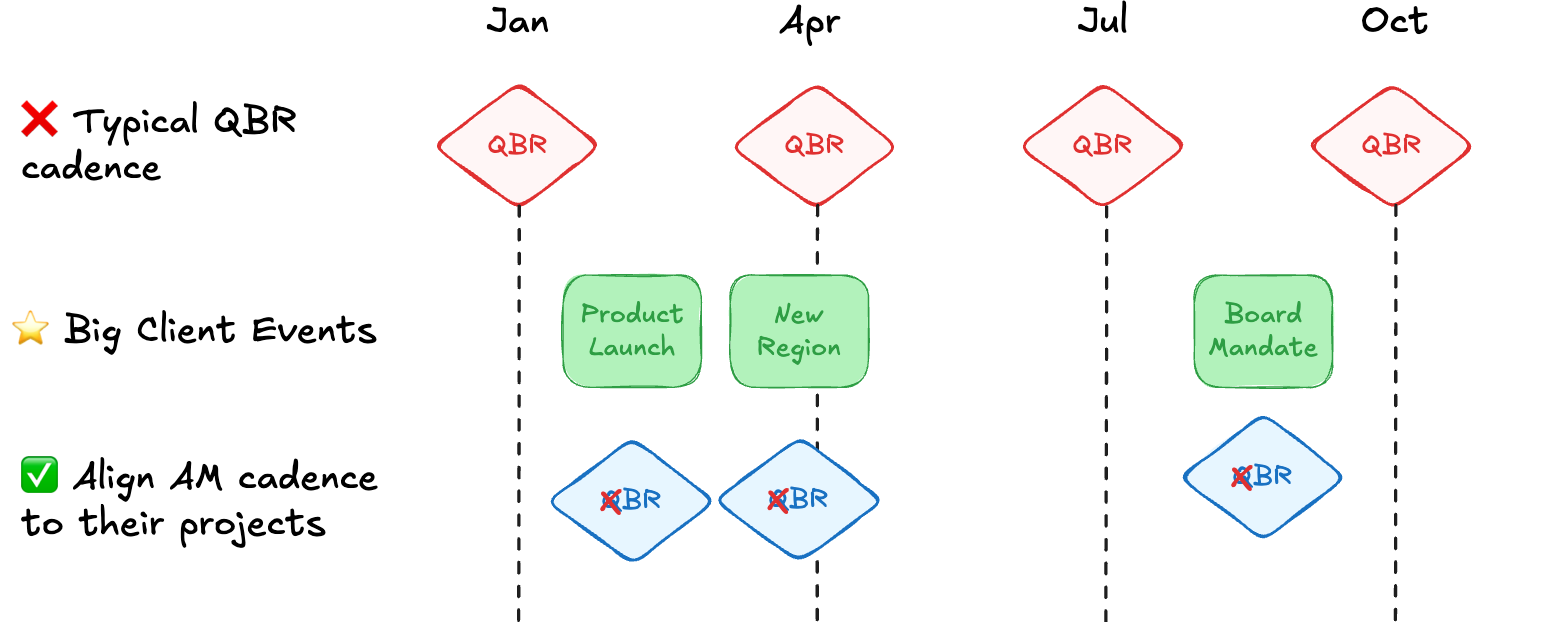
The QBR is the worst place to find expansion opportunities. Using an arbitrary date on the calendar means you’ll miss chances to expand the account unless the client thinks of you and proactively reaches out, which is the equivalent of relying entirely on inbound.
For example, if you sell payment processing and your customer has a major product launch in February, waiting until your March QBR means you’ll miss the chance to upsell their processing package to handle the increased transaction volume from the launch.
You have to be on constant lookout for “Big Client Events” AKA any meaningful customer initiative or trigger that might mean they need more of what you sell.
If Big Client Events are your expansion triggers, here’s where to find them.
Where to Find Big Client Events
There’s technically a million places you could find reasons to expand, but Mark recommends starting with these 5:
- Handoff: Get the AE who sold the deal to clue you in on the priorities and projects on the horizon that might create expansion opportunities.
- Implementation: You probably shouldn’t join every implementation call, but you’ll want to task your team with keeping an ear out for things that might warrant expansion.
- Mid-Engagement: Get your CSM or AE to warm-intro you to leadership. This might require you to send a moderately personalized email or even pick up the phone and call.
- Renewal Rhythm: Instead of talking about just flat renewal, pull the conversation up to additional priorities and projects beyond the original use case.
- QBRs: Your last resort.
These 5 places put you in front of people likely to know exec priorities. The next step is figuring out whether any of those priorities can become an expansion opportunity.
How to Run Expansion Discovery
The “discovery” part of expansion discovery doesn’t differ too much from the net-new discovery skills we talk about all the time. That said, the “sandwich” of how you tee up and wrap expansion discovery is a bit different.
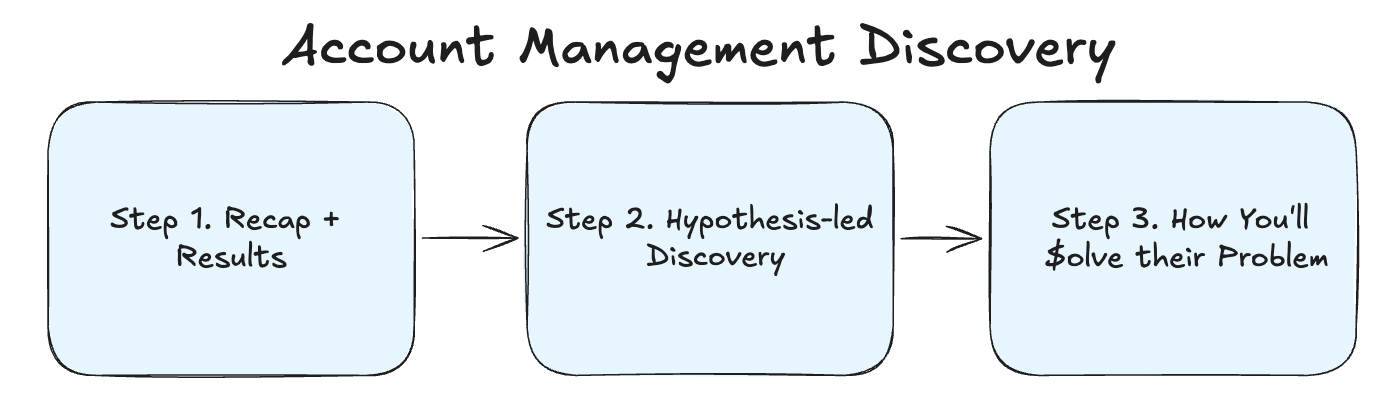
Step 1: Recap + Results 2
Reorient them around why they originally became a customer and how well you’ve delivered on that. Proof earns you the right to offer dessert expansion.
Step 2: Hypothesis-led Discovery
Now that you’ve proven results, ask them some version of “what’s next?” The best way to do this is to offer your hypothesis of what you think they care about based on everything you’ve learned from working the account.
Step 3: How You’ll $olve The Next Problem
Share how you can help them solve whatever problem or priority they care about. Sometimes this isn’t an expansion at all. It’s just getting your CSM to work with their below-the-line team on projects related to what they already bought. But sometimes solving the next problem means:
- Buying new products
- Expanding scope: new business units, regions, audiences, user types
- Commercial mechanics: early renewal, prepay, restructure, term extension
Or some combination of the 3.
There you have it. Upsell and expand your existing book of business by showing them the proof of the value you’ve already delivered, then offer them the dessert!
Check out the Live Tactic Teardown with Mark + Armand here.