

Today we're breaking down a world-class cold email so you can learn exactly how to start raking in the replies yourself.
For context: this example is from a rep who sells clinical trial software to biotech companies.
Here's some of the keys to success we're grading this email against:
- Subject Line: 3-4 words, make it about them, no selling
- Personalized Problem: A trigger/signal + the problem we think it caused for them
- What You Do: One sentence max.
- The CTA: An interest-based ask, not a meeting request (yet)
Let's dive in.
1: The Subject Line
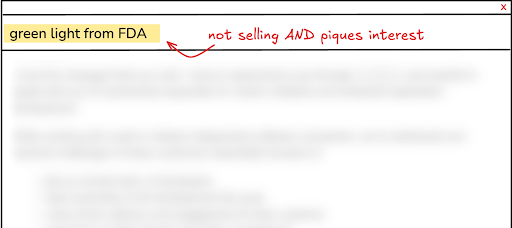
If you can’t get your email opened, it doesn’t matter how great your product or pitch is. You could be giving away winning lottery tickets(!) and you’d still get ignored.
A strong subject line earns you the right for your prospect to even read your email.
The four golden rules of a great subject line:
- Keep it short (4 words max)
- No selling in the subject line!
- Pique their interest
- Make it about them
The test for a great subject line: It should only make sense to the one person receiving it.
In this example, the prospect’s company just got FDA approval. If you sent "green light from FDA" to anyone else on your list, they wouldn’t know what the heck you were talking about.
Show your prospect that your email is meant for them and them only, and you’ll earn way more opens than using “scalable” subject lines.
More examples of subject lines that pass the test:
- wrassling (sent to a former college wrestler)
- pizza (sent to someone whose LinkedIn screamed pizza obsession)
- sequoia + startupco + 30MPC (investor connection used as a bridge)
- she shed (founder who literally started her business in a backyard shed)
Contrary to popular belief, your subject line does NOT have to be related to what your product does.
The only job of the subject line is to get them to open the email and the best way to do that is make it unmistakably about them.
2: The Personalized Problem
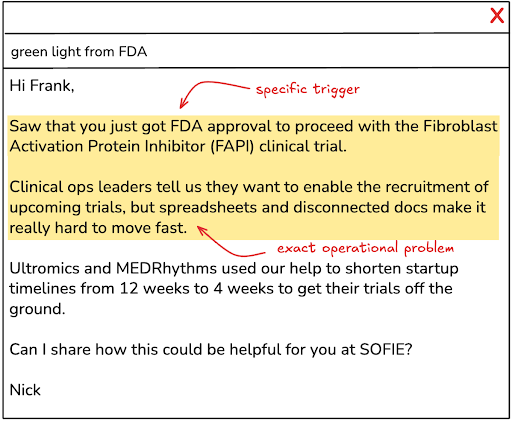
Now that you’ve earned the open, it’s time to earn the read.
This is where your “pitch” starts.
Skip the BS pleasantries and immediately open with a specific trigger that proves you did your research.
In this example, the rep calls out the FDA approval, and then hypothesizes the problem they think the prospect is dealing with as a result of the approval. In this case, it’s a challenge with recruitment related to upcoming trials.
Pro Tip: Make your problem description as specific as you can. Your goal is to transport them back to the crappiest part of their week when they thought damn… I really wish there was a way for me to not do this anymore.
When you demonstrate that you understand the exact problem they’re facing, you establish yourself as an industry insider who “gets” their business… not an email spammer.
3: How you solve their problem
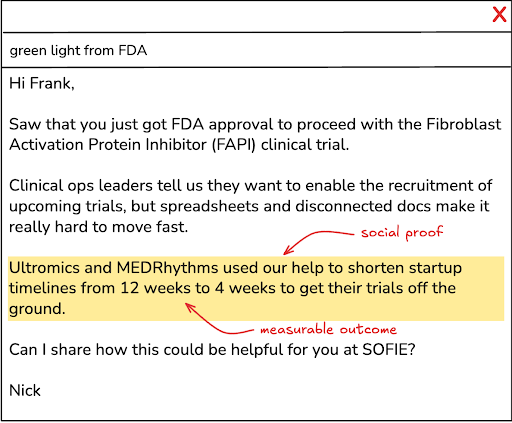
Now that we’ve named the problem, next comes your chance to explain how you fix it!
Keep this part very short. This example doesn’t talk about the product at all. Instead, it focuses on social proof and outcomes.
Two keys to success:
- Social proof: Pick companies that are similar to the company you’re reaching out to. Name dropping Wal-Mart might actually hurt you if you’re reaching out to a mom and pop convenience store.
A measurable outcome: Keep this specific enough to be believable. You don't need to claim 40,000% ROI to get a meeting.
If this part seems a bit underwhelming, that’s on purpose. The real work is done in your personalized problem description. If you nail that, the solution almost sells itself.
4: The CTA

If you want this part simple and easy, just ask some variant of “do you want to learn more?”
A rule of thumb that spans all aspects of selling: Only ask your prospect to make one decision at a time. Asking “Are you available on Monday at 2:00 or Wednesday at 4:00?” forces them to both reference their calendar AND evaluate whether or not they’re even interested.
The single most important thing is to validate their interest before anything else. Starting with a small ask (are you open to learning more?) increases your chances of an initial response, at which point you can handle meeting logistics.
That’s a Wrap!
To recap, here’s your cold email keys to success:
- Subject Line: 3-4 words, about them, no selling
- Personalized Problem: trigger + hypothesized pain. This section earns you the meeting.
- What You Do: one sentence, social proof + outcomes.
- Interest-Based CTA: Only ask them to make 1 decision at a time.
Now, you could tackle this manually, but there are ways to make this 1 million times easier using AI, all without sacrificing an ounce of quality. If you want to scale the right way, our cold email course helps (this email example actually came from our Cold Email Course with Jason Bay!)
Cold Email Course