

We've all heard this advice before. "Never share the price until the customer thinks it's more." And frankly, it's nonsense. It tanks trust, drags deals into ambush territory, and trains buyers to assume your price is fake.
Here's the thing... Confidence about price is what makes buyers more comfortable with buying. You don't negotiate the price of your groceries, your Uber, or your movie tickets because the price is the price. B2B should be the same way.
Today, we’re going to teach you WHEN to deliver price and HOW to deliver price. This newsletter is split into 4 chapters:
- Chapter 1: When To Deliver Price
- Chapter 2: Set the Range Early
- Chapter 3: Lay Out The Structure With 3 Levers
- Chapter 4: Hold the Fourth Lever for The Negotiating Event
P.S. The new negotiation course is live. Check it out right here.
Chapter 1: When To Deliver The Price
By now, it should come as no surprise that I preach transparency over and over again. So when should you share the price? The moment you're asked. Don't dodge it. Don't avoid it like the plague. Deliver it confidently:
"Great question! Our pricing is built on a sound basis I can walk you through in 90 seconds. Based on what I've heard so far, here's the range, and here's the structure behind it."
The second you avoid the question, you signal that your price isn't real. That weakens your qualification process, creates uncertainty, and starts eroding trust with your buyer. If you're confident in the value you provide, your pricing should never feel like something you need to hide.
If you're asked for your price, answer them. Don't tell them, "I'll get back to that" or "depends on a lot of factors". Set up a sound basis from the beginning.
Now, what if they don't ask? That's important data. You're likely dealing with someone below the line or a non-ICP company.
Once you've committed to delivering a price, the first thing out of your mouth is the range. That’s up next.
Chapter 2: What Price Do You Quote?
You should be presenting your price range early, based on what you know about similar companies. This qualifies the deal and surface mismatches before you both end up wasting your time. So... how do you present your price?
"Based on my understanding of similar companies to yours, your pricing is between $X and $Y. If that's completely off for your company, let's talk about that now."
If you're selling a 6-7 figure solution to a buyer who has a 4-5 figure budget, one of you is in the wrong conversation. It's better for you both if you find that out now, and not 8 weeks into working the deal.
By approaching the price this way you're qualifying the deal in just one sentence. This anchors the buyer in your reality before they anchor you in theirs. And this is the kind of confidence that makes the price become the price (not a negotiation chip).
The range tells them what. The structure tells them why. We’ll over the structure in the next chapter.
Chapter 3: Lay Out The Structure With 3 Levers
After you've talked about and established the price range, lay out the pricing structure based on the first 3 levers only. This gives your buyer the "why" behind your number and pre-frames every concession ask later in the cycle.
Open the conversation with transparency.
"We base our pricing on three things you can think of as levers. Pull one, and the price changes. This is what they are:"
- Lever 1: Volume (standard tiers): "The more you commit to buy, the better the unit price. You're looking at our [X-tier] price right now."
- Lever 2: Timing of Cash (standard terms): "Our pricing assumes [annual billing on NET30]. Faster payment is something we'll pay you back for."
- Lever 3: Length of Commitment (standard term): "The longer you lock in, the better the price. You're looking at our [3 year] tier."
Laying out your price structure signals transparency, gives them a menu, and pre-frames any future negotiations as a trade, not a discount. Every future ask from now on has a predictable counter built into it.
These 3 levers go in the proposal.... the fourth waits for a specific moment.
Chapter 4: Wait... But I Thought There Were FOUR Levers
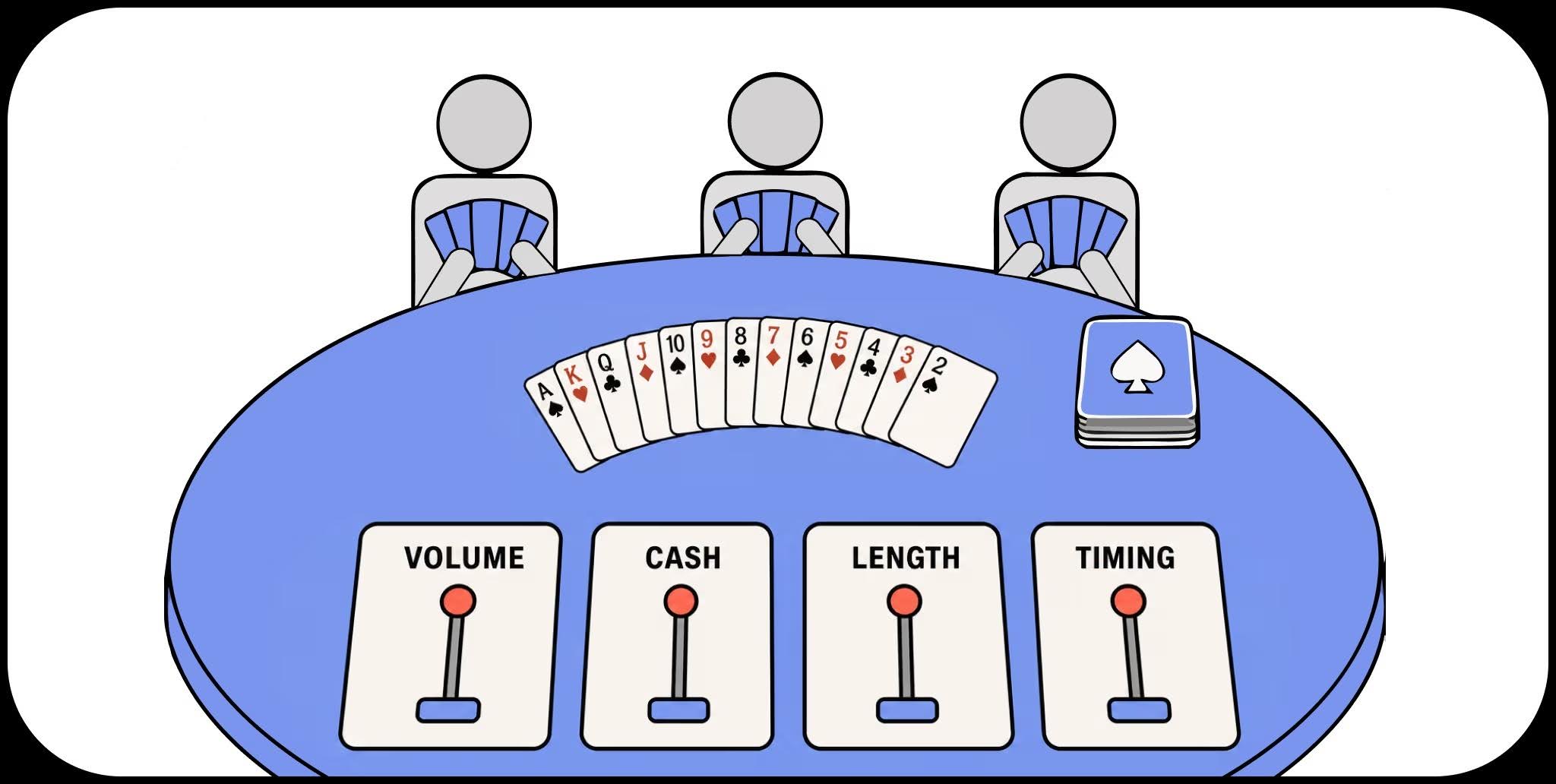
And four there are... But don't introduce the Timing of the Deal Lever until the negotiation event or when the buyer can properly talk about a close date. The Timing of the deal lever will only work when it's mutual. If it's not and you introduce it too early you risk it looking like a fake-expiring discount, which slows deals down.
Introduce the Timing of the Deal Lever when your buyer gives you a trigger to discuss it. For example: The buyer starts talking timeline or asks you for a concession. That's when you bring out the fourth lever.
You could introduce it as follows:
"Up until now we've talked about three levers. But... there's a fourth: the Timing of the Deal. If we can both commit to a close date, in writing, that's worth something to us and we'd pay you for it."
This gives you an incredibly clean handoff from positioning to negotiating. The buyer was already operating in your three lever world. Adding the fourth lever feels like a natural extension, not a trick.
Make sure you're practicing the two talk tracks.
- The 3 levers and price range (used in positioning)
- All 4 of the levers (used at the negotiating event)
The Pricing Move That Builds Trust

Well, what are your thoughts? Have I gone bonkers or am I on to something? The cool thing about everything I just talked about is that it's now an on-demand course. Yup... You read that right.
This has been something I always wanted to do and was heavily advised to do.
But without someone nailing me down, it was never gonna happen.
In walks Armand from 30 Minutes to President's Club. He nailed me down.
After weeks of planning, days in the studio, and their team working their magic editing, I’m excited to announce…
The 30MPC x Todd Caponi 4 Levers Negotiating Course is live right here.
Get the Course