Data from 300M+ calls on what separates top reps from everyone else. Drop your email to unlock it.
By submitting, you agree to receive emails from 30MPC. Unsubscribe anytime.
Cold calling mastery — data from 300M+ calls across four chapters
30MPC x Gong
300M+ calls analyzed
How To Master Cold Calls
A data-backed guide based on 300M+ cold calls recorded on Gong to show what top reps do differently.
300M+
We analyzed 300M+ cold calls recorded on Gong's Revenue Intelligence Platform
to break down the openers, pitch language, objection patterns, and voicemail habits that separate 45 calls per meeting from 1,402.
01.
Is Cold Calling Actually Dead?
02.
Nailing The Opener And Pitch
03.
Navigating Objections
04.
Leaving Voicemails And Maximizing Your Connect Rate
Cold-call data from Gong. Tactics translated by 30MPC.
Chapter 01
Is cold calling actually worth it?
Short answer: yes — but only for reps who do it well. The gap between average and top performers is enormous, and it's not about effort. Here's what the data actually shows.
Connect rate — how often does anyone pick up?
Average rep vs. top rep
Out of every 100 dials made
Average rep
5.4 people answer
Top rep
13.3 people answer
▶
Why is the gap so large?
Top reps actively mark bad numbers as they go and prioritize direct lines over company switchboards. Fewer wasted dials, more real conversations. At 30–40 dials per hour, a top rep gets roughly
5 live conversations per hour
while an average rep gets about 2.
Of people who pick up — how many become meetings?
Out of every 100 conversations
Average rep
4.6 become meetings
Top rep
16.7 become meetings
▶
What explains this?
Same phones, same types of prospects — completely different outcomes. An average rep converts
1 in 22 conversations
into a meeting. A top rep converts
1 in 6
. The rest of this guide is about closing that gap.
The bottom line on volume
Dials to book one meeting
The compounding effect of connect rate × conversion rate
402
Average rep
~10 hrs of dialing
vs
45
Top rep
~1 hr of dialing
▶
How is this calculated?
Multiply connect rate × conversion rate: 13.3% × 16.7% ≈ 1 meeting per 45 dials. At 30–40 dials per hour, that's
roughly one meeting per hour
. For an average rep it's closer to a full workday per meeting booked.
Do calls help even when nobody answers?
Email reply rate — with vs. without cold calls in the sequence
Emails only
1.81% reply rate
Calls added
3.44% reply rate
▶
Why does a missed call help emails?
When a prospect sees a missed call from an unfamiliar number, they're primed to notice your next email. The call creates
multichannel awareness
— you're no longer just another email, you're someone who also called. Even a completely unconnected dial session has real downstream value.
Chapter 02
What to say
How you open the call and what you say in the first 30 seconds determines whether there's even a conversation to have. The data on openers and pitch language is pretty unambiguous.
Openers — tap any to see the why and talk track
2.15%
"Did I catch you at a bad time?"
Hands the prospect an instant exit
Tap for why + talk track
7.6%
"How's it going?"
Sounds friendly, lands hollow
Tap for why + talk track
11.18%
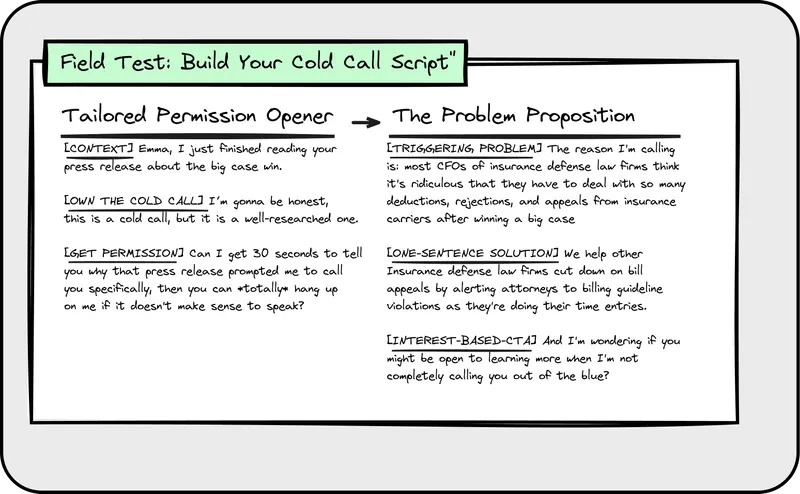
Permission-based opener
Own the cold call, ask for 30 seconds
Tap for why + talk track
11.24%
"Heard the name tossed around"
Lead with peer familiarity
Tap for why + talk track
Percentages = % of calls where the rep got past the opener into a real conversation
Pitch language — what you say after the opener
Meeting booked rate by pitch style
Out of 100 conversations that got past the opener — how many became booked meetings?
Buzzwords & jargon
5.5%
"We're an all-in-one platform that revolutionizes your single source of truth."
Tap to learn more
Only 5–6 meetings per 100 conversations. Jargon signals you don't know their problems — you're reciting a script that could apply to anyone. They've heard it a hundred times and it means nothing.
Social proof
12%
"We helped Salesforce cut ramp time by 40%."
Tap to learn more
Roughly 1 in 8 conversations became a meeting. Mentioning recognizable customers builds credibility fast — but the prospect still cares more about their own pain than someone else's win. Good, not great.
Problem language
16%
"Most VPs of Sales I talk to are frustrated that reps can't get past the first objection — they coach the same thing over and over and it never sticks."
Tap to learn more
Nearly 1 in 6 conversations became a meeting. When you describe their pain in specific, triggering detail — frustrated, anxious, overwhelmed — they feel understood. Your solution becomes impossible to ignore because you've already proven you get their world.
Chapter 03
Handling objections
Most objections aren't real — they're reflexive reactions to being interrupted. Understanding that changes how you respond to them.
The 5 most common objections — tap any to see how to handle it
These 5 account for 74% of every objection you'll ever hear on a cold call
01
Not interested
17%
Dismissive
A brush-off to the interruption itself — not to you or your product. Don't argue. Acknowledge and pivot:
"That's fair — most people say that before they hear why I'm calling specifically."
02
Product fit ("not for us")
17%
Dismissive
Usually a knee-jerk assumption, not a real assessment. Ask:
"What makes you say that?"
— you'll often find they assumed something incorrect about what you do. Create enough doubt that they're willing to hear 30 more seconds.
03
No budget
16%
Situational
Budget exists for things that are a priority. Your job is to make the pain feel urgent enough that finding budget becomes worthwhile. Don't fight the budget objection — fight for the priority conversation.
04
Not my responsibility
13%
Dismissive
Great — ask who does own it.
"That makes sense — who on your team would typically handle something like this?"
Don't hang up without a name. You just turned a dead end into a warm referral.
05
Hang up (no words)
11%
Dismissive
Nothing to handle — dial the next one immediately. The only thing worse than a hang-up is letting it affect your next three calls. It's not personal. It never is.
How long does a successful call actually take?
Meeting booked rate by call duration
Calls under 3 minutes almost never convert
0%
1%
4%
7%
13%
16%
21%
24%
24%
30%
<1m
1m
2m
3m
4m
5m
6m
7m
8m
9m
Blue = the zone where meetings get booked
▶
What's happening at the 5-minute mark?
The median successful call is
4.8 minutes
. That's typically enough time to get through at least 2 objections. If you fold at the first "not interested," you statistically never had a real shot. Staying on the line and handling pushback is what separates the booked meetings from the dead ends.
Also: hitting a gatekeeper instead of your actual prospect
reduces booking chances by 39%
. Dial direct lines and off-hours when possible.
The three types of objections
Knowing the type changes how you respond
Dismissive — most common
They're not objecting to you — they're objecting to being interrupted. Not interested · Hang up · I'm in a meeting · Send me an email
Situational
Their current situation doesn't seem to fit. No budget · No bandwidth · Need to hire first
Existing solution
They already have something. We do it in-house · Using a competitor · Locked in a contract
Chapter 04
Timing & voicemail
When you call and what you do with voicemail have a measurable impact on your connect rate. Small tactical decisions that compound over hundreds of dials.
Voicemail — the tradeoff
What voicemails do to your future connect rate
After leaving a voicemail for this prospect
Connect rate after voicemail
5.17%
vs 7.18% normally (−28%)
Email reply rate after voicemail
5.87%
vs 2.73% without (+115%)
▶
So what's the right strategy?
Leave
1–2 voicemails
per prospect. The first one nearly doubles your email reply rate by creating multichannel familiarity. But after 2, you're conditioning the prospect to ignore your number. At that point,
rotate to a different phone number
and keep them in your email sequence.
How many times to call before moving on
Connect rate drops consistently after dial 2
1st call
7.1%
fresh
2nd call
7.2%
still strong
3rd call
6.3%
dropping
4th call
5.9%
noticeably lower
5th call
5.0%
move on
▶
Doesn't persistence pay off?
Not here. After 5 dials the prospect has seen your number enough to be passively ignoring it. Pull them from your call list, keep them in your email sequence, and re-add to calls in 60–90 days with a fresh angle. Time changes context.
Best time of day to cold call
Connect rate by hour
Call between 9–11am. Rates drop steadily after noon and keep falling through the afternoon.
5.5
7.2
8.0
7.6
7.4
6.9
7.2
7.5
6.7
6.3
6.0
8am
9am
10am
11am
12pm
1pm
2pm
3pm
4pm
5pm
6pm
▶
Why is morning so much better?
People are at their desks and not yet buried in back-to-back meetings. As the day goes on they become harder to reach and more mentally depleted — less open to an unexpected conversation. The practical takeaway:
block your first 1–2 hours for cold calls
, before email and Slack pull your attention elsewhere.
Want The Full Playbook?
If You Liked The Data, Get The Tactics Behind It.
Cold Calls to Presidents Club teaches you every part of the call — how to open, reveal a problem, handle objections, and land the meeting — with talk tracks you can use on your next call.