

What’s up folks! Armand here, the grouchier host with reasonably larger ears 🐵
You might’ve heard I took over our sales team 3 months ago to subject myself to the pain of being a VP of Sales again in hopes of feeling something inside.
One of the first things we overhauled was our end-to-end sales process. AKA how we get customers from “who the hell are you” to “the contract is approved” inch by inch by inch.
Why? Because a good sales process helps your reps two things:
- A predictable path to close good deals
- A stage gates that tell you if have a crappy deal (that you should throw in the trash)
In April, we closed lost nearly every deal in our pipeline.
3 months later… we raised our average ACV from $20k → $50k+, closed our biggest deal ever, and are on on pace to 3x our biggest quarter ever.
This newsletter will breakdown that process in three parts.
- Map the 5 agreements
- Map the ways you get those agreements
- Example: Do not let your customer take your role as the doctor
Let’s ride.
Map The 5 Agreements
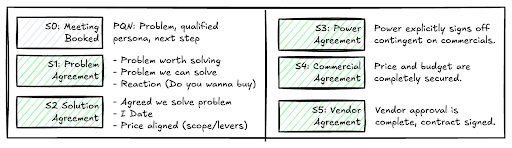
Most broken sales processes are “seller-centric” sales processes that sound like this:
- "I need to do a discovery call."
- "Then a demo."
- "Then a proposal call."
- "Then a check-in".
The problem is this is an inaccurate reflection of how customers buy things. One customer might take 2-3 discovery calls or process deep dives to get to a problem. Another might be ready for a harbor tour demo and pricing in a single call.
❌ So instead of thinking about the meetings you're doing…
✅ Think about the agreements your customer is making.
We sell an enablement program that helps teams get to President’s Club.
There are 5 agreements we need to hear from prospects. We can get these things in 1-2 calls in SMB, 3-10 calls in MM, or 10-20+ calls in ENT:
- Problem Agreement: Is there a problem that is worth solving (ie: win rates down due to surface level discovery) AND that we can solve (ie: we can’t solve morale issues)?
- Solution Agreement: Does the champion agree that we’ve got both the right sales curriculum AND program structure to actually drive a change?
- Power Agreement: Does the buying committee agree to both of the above?
- Commercial Agreement: Do they agree it's worth the price?
- Vendor Approval: Have they completed IT/legal review and signed the contract?
Notice: These are the questions a buyer is trying to answer in their minds.
It’s on us to DESIGN THE RIGHT STEPS ON A CUSTOMER-BY-CUSTOMER BASIS to answer each question.
Like this.
Map the ways you get those agreements
Let's use our mid-market sales motion ($50-100k) as an example.
We get Problem Agreement through…
- A discovery call
- AND MAYBE a sequence audit or discovery call review if that wasn’t enough…
We get Solution Agreement through…
- A deep dive demo of our program
- AND MAYBE a curriculum test drive if they’re not sure about the quality of the content.
We get Power Agreement through…
- Recap and Roll with each stakeholder (recap what we learned + roll in their POV)
- AND MAYBE an implementation workshop if they’re not sure how this’ll be customized to their SDR, AE, AM, and CS orgs.
- AND MAYBE a customer reference if they believe it’s too good to be true.
We get Commercial Agreement through…
- A proposal meeting
- AND MAYBE a one-page business case for finance
- AND MAYBE a good old procurement meat grinder session
We get Vendor Approval through…
- A signed contract
- AND MAYBE a redline deadline or IT:IT nerd call to make vendor onboarding move faster
Notice: All customer must pass through all agreements. But we may have to use more tools for tough customers (or fewer tools for hot deals).
This is what a great seller does when they’re at the next level of the game.
They know when to slow a deal down because a customer isn't ready for a proposal yet.
And they know when to speed it up when they've got a hot one.
Example: Do not let your customer take your role as the doctor
There are times where a customer will prescribe you with something to do.
- “I want a reference call”
- “I want a pilot”
- “I want you to meet with 22 of my SDRs”
You are not a monkey. Do not do whatever the customer tells you to do.
Your job in these moments is to ask them what they are trying to GET out of that… then you as the doctor prescribe them the right treatment.
We had a $90k deal who asked for a reference check as we were going into exec approvals.
I asked:
Armand: We love intro-ing customers to customers. I'm curious. What are you hoping to get out of that reference call, just so I can come prepared?
Them: We’ll, I’m trying to see exactly how you all will help us tailor this to our hardware + software sales motion and I figured a reference could speak to that experience.
A reference call is not the most efficient way to answer that question.
Instead, we ran an implementation call where we literally walked them through how we would tailor one of their playbooks to their sales motion which is real proof instead of social proof.
***
That’s a wrap folks. If you can’t tell, I’m absolutely fired up running this thing.
1: If you want us to help your team sell like 30MPC, learn more about our program here.
2: If you want to steal your own five-stage process template, scroll below, and you can grab it free.