

Welcome to Exec Selling & Multithreading Week 2/4 with the one and only, Jen Allen-Knuth.
Today, we’re covering data-backed tactics to book your next executive meeting:
- The Data-Backed Cold Email Formula, Built for Execs
- ✅ Data-Backed Tactics to Book Your Next Executive Meeting
- Advanced Executive Multithreading and Team Selling Strategies
- $50M+ Worth of Sales Knowledge in 12 Minutes
If you don’t know Jen, she's a former enterprise seller who carried an individual quota at Corporate Executive Board and The Challenger Sale Company for 18 years, closing 6 and 7-figure deals with Fortune 500 brands.
Now she runs DemandJen, a sales-training firm trusted by GE, G2, IBM, Bloomberg Industry Group, Instructure, Sprout Social, Autodesk and more.
And if you like this, you’ll love the Ultimate Multithreading and Selling to the C-Suite Report that includes more than 20+ insights on how to close bigger deals with executives.
Intro
Securing a second call after discovery with an executive is never guaranteed, and most reps don’t realize they’ve already lost it before the call even ends.
In fact, Gong data show that you’re 22% less likely to earn a next step with an executive compared to a non-executive after a discovery call:
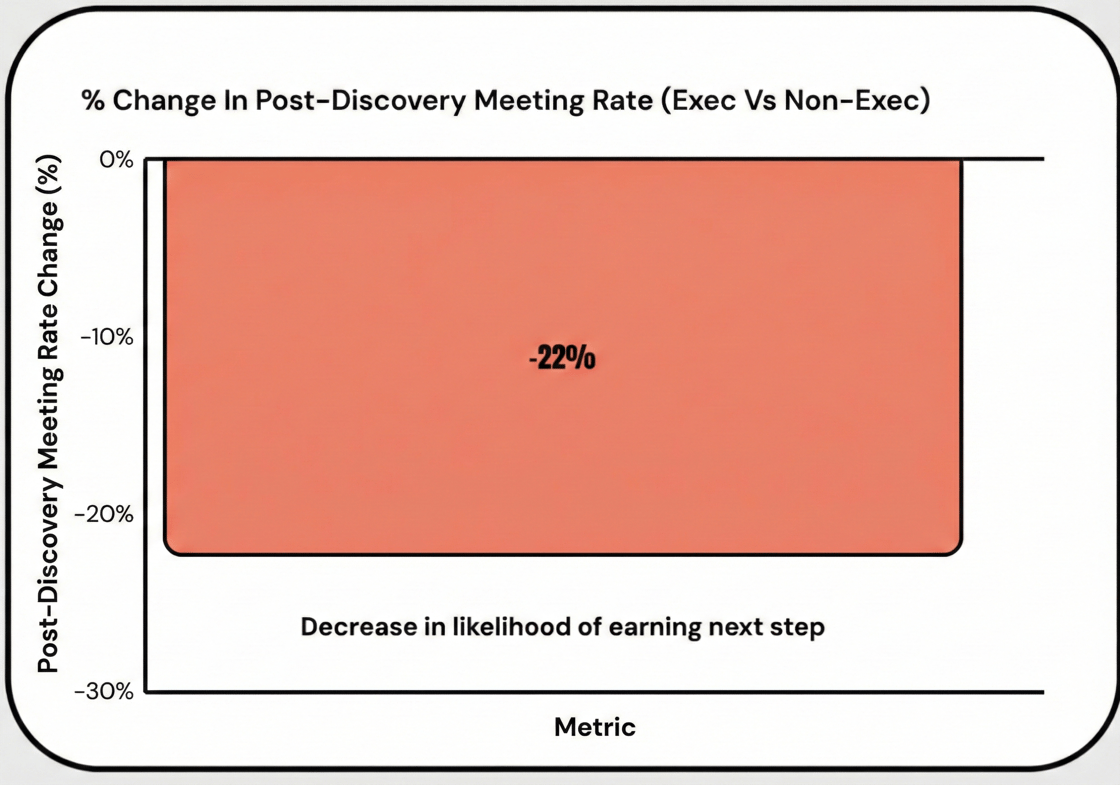
Not because executives are harder to sell, but because most reps treat executive discovery calls like any other.
They pepper executives with tactical questions, rely on generic slide decks, and start pitching solutions too early.
As a result, the conversation feels noisy, generic, and not worth an executive’s time.
So how do you actually run a discovery call that earns an executive’s respect and a second meeting?
We analyzed 1M+ executive sales cycles in partnership with Gong and Jen Allen-Knuth (Sold $50M+ in enterprise sales, ex-Challenger) to learn exactly what it takes to run a successful discovery call with an executive.
We’ll break down the data and tactics behind crushing executive discovery in three sections:
- The exact amount of time you should spend building rapport
- Why the best reps talk less than you think
- What happens when you talk about ROI and solutions
And if you like this, you’ll love the Ultimate Multithreading and Selling to the C-Suite Report that includes more than 20+ insights on how to close bigger deals with executives.
1. The exact amount of time you should spend building rapport
An executive’s calendar is often booked back-to-back, which leaves many sellers unsure how much time to spend on rapport.
Some default to small talk. Others skip rapport entirely and jump straight into business.
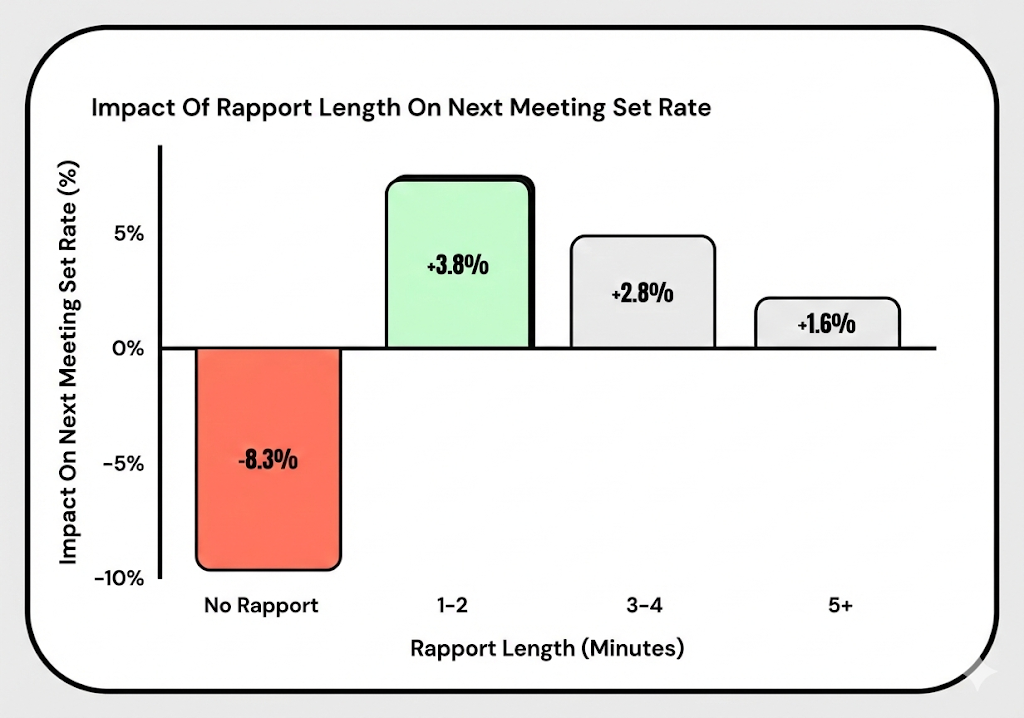
The data show that neither of those extremes actually works.
Gong data indicate that skipping rapport can reduce next meeting set rates by up to 8.3%, while spending just 1 to 2 minutes on rapport increases them by 3.8%.
The difference is how that time is used.
Jen sees this play out constantly in executive conversations. The reps who earn second meetings don’t use rapport to be likable; they use it to establish relevance.
Effective rapport with executives is not about weekends or weather. It is about their business.
Here’s the exact talk track Jen uses to build rapport with executives:
“Before we get too far into the conversation, mind if I share what I learned about your firm? I don’t want to assume I have all of the correct answers simply because I researched your company beforehand.
(Share research here)
What did I get wrong?”
When rapport reinforces credibility instead of filling space, it earns attention rather than wasting time.
2. Why the best reps talk less than you think

Reps often approach discovery like they’re playing a game of 20 questions. The result is a one-sided interrogation that executives quickly tune out of.
Gong data show that top reps ask fewer questions on discovery calls, and that asking too many questions correlated with lower win rates.
That’s not because executives don’t want to answer questions. It’s because a high volume of generic, scripted questions signals low preparation and weak perspective.
Jen avoids prompts like “What’s the top priority for the business?” or “What’s challenging about that?” because they’re too generic — they make you sound like any other salesperson.
Instead, she leads with context before asking a question, so it feels like a conversation, not an interview:
Business priorities: “I don’t work within your four walls, but it seems like ACME is focused on X. I thought it might be because of Y. What did I get wrong?”
Challenges: “One of the things we hear that makes that tough is X. How is that different from what you’re seeing?”
By grounding questions in research and social proof, you can ask fewer questions and get far better answers because showing credibility builds trust with executives.
That’s what moves you out of the “scripted salesperson” bucket and gets executives to open up with the context you actually need to position your solution later.
3. What happens when you talk about ROI and solutions
-Feb-02-2026-02-08-02-6466-AM.png)
Reps often spend a large portion of discovery uncovering an executive’s priorities, then immediately pivot to pitching their product.
Gong data reveal that reps are more likely to earn a next step when they limit how much they talk about their solution during discovery.
That’s because it’s nearly impossible to fully understand an executive’s business, initiatives, and challenges in a single call, making any early recommendation feel premature.
Instead, treat discovery as the place to understand the problem, not solve it.
Rather than pitching, Jen uses this time to understand how the executive is solving the problem today, setting up her solution as a thoughtful alternative later in the process:
“Often, the way other firms address that is by XYZ, because of ABC. How is that different from how you’re addressing it today?”
-3.png)
The same dynamic applies to ROI.
Gong data show that mentioning ROI at all during discovery correlated with lower next-meeting set rates with executives.
Early ROI talk forces assumptions before the executive has fully aligned on the problem. Rather than signaling value, inflated numbers introduce uncertainty and skepticism.
Instead, Jen avoids ROI entirely and focuses on the cost of inaction (COI). ROI is the return if you decide to buy something. COI is the cost of not doing anything at all.
The easiest way to calculate COI is to use an industry peer as a benchmark
- Recap the problem: It looks like there is a budget deficit of $X for city of X. With tightening budgets, many other city officials are looking for ways to increase productivity of their IT teams without increasing headcount.
- Cite a peer benchmark: City of Philly is using AI to predict wifi downtime, and resolve it remotely before the downtime event happens. This reduced their onsite visits by X% and achieved X% downtime events (a reduction of 50%).
Now the executive realizes they’re leaving a 50% reduction in downtime on the table, which is something that we can formally quantify later in the sales cycle.
The verdict
Executive discovery is harder than manager-level discovery, but leading with credibility, anchoring on strategic objectives, and staying client-focused dramatically increase your chances of earning a second meeting.
Want more? The Ultimate Multithreading and Selling to the C-Suite Report breaks down exactly how top reps win more (and bigger) executive-level deals.
And when you're ready, this article is a sneak peek of our course, Selling to The C-Suite. Check out the course here.