

It’s very common beginner sales advice that you should "just ask lots of questions and be curious”.
While that’s not necessarily bad advice, it somewhat loses sight of what our prospects are actually hoping to get out of meeting with us.
Prospects don’t show up to sales calls with the goal of answering all your questions…they show up to get their questions answered!
“Being curious” might help YOU, but it doesn’t always help THEM.
Well-balanced discovery needs to feel like a give-and-take conversation where both you AND the prospect are “discovering” in real time.
Today we’re covering 5 discovery techniques to help you make your discovery calls feel a bit more balanced and conversational:
- Vertical questions to create conversation depth
- Playbacks to show you’re listening
- Pile-ons to prove that you understand
- Praise to reinforce them solving the problem
- Parallel stories to show how you can help
Ready to rock? First up is vertical questions.
#1: Vertical Questions

Discovery calls that feel like interrogations often involve horizontal questioning where you bounce from topic to topic with your questions:
- Topic 1: How do you manage your client billing process?
- Topic 2: What time tracking software do you use?
- Topic 3: How often do you refresh your outstanding receivables?
- Topic 4: What’s your team look like?
Horizontal questioning is exhausting because each question literally has nothing to do with the previous one. Not only does this show that you're not listening, it also tends to not uncover any real business problems.
For prospects, it feels like you’re just running through a random survey of whatever came to mind and not really trying to help them.
Vertical questions are better. They use the previous answer to build the next question:
- Situation: How do you run your client billing process? (they say ACME Billing software)
- Problem: Typically when someone's using ACME Billing, they usually tell us they’re running into bill format errors or that clients are slow to pay. Which is it for you? (they say it's bill format errors)
- Impact Story: I have to imagine you didn't wake up and think you needed to look into new billing software just because of the occasional error. When was the moment you realized this was a problem? (they give a story about a huge billing error that cost $$$)
Every answer they give allows you to understand their problem more deeply. It starts with a high level situation. Then a problem. Then a story to make that problem feel real.
That's a lot more compelling than peppering them with unrelated questions and hoping something lands.
Vertical questions uncover great information, but if all you do is ask questions, you start to sound like an inquisitive three year old, not a trusted advisor.
The best sellers show that they’re actively listening to buy themselves more questions. That’s up next.
#2: Playbacks
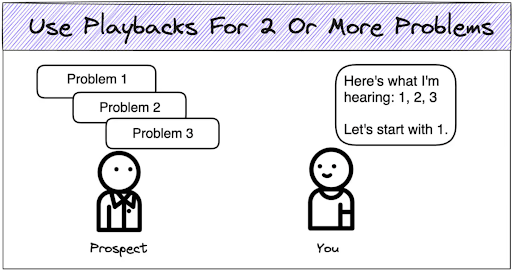
The playback is the most basic form of active listening. All you're doing is summarizing what you've heard from your prospect in your own words to show that what they’re saying is landing.
If you went to your therapist and all they said was “tell me more about that?” every single time you complained about your ex, your job, and your living situation, you'd start to wonder if they were actually picking up what you were putting down.
Prospects feel the same way when the only thing out of your mouth is questions.
Use playbacks when your prospect goes on a monologue or shares a big chunk of information. The most common place is right at the top of the call after your prospect gives you their “upfront brain dump”.
When you Playback, try to taper their monologue down to the problems that matter most. Here's what that sounds like for a rep selling an ERP system to a law firm:
(Recap) “Just to play back what I'm hearing, it sounds like there are 3 big things you're focused on.
(Confirm) First, you've got 3 or 4 practice areas and you're trying to figure out which ones are actually making money. Second, client intake isn't as smooth as it needs to be when clients want help in multiple areas. And third, you're getting a lot of pushback from insurance companies on your billing formats.
(Steer) If you're not against it, could I ask a couple more questions about the client intake process? I know that's an area that can get messy."
Playbacks accomplish 3 big things:
- Your prospect feels heard, not like they just dumped information into a void.
- You get a free comprehension check where they’ll correct you if you missed something
- You get to steer the conversation toward the problems you can help with most, without it feeling like you're hijacking the call.
Playbacks show you’re listening, but if that’s your only move, you’ll start to sound like a parrot. To prove you actually understand their world, you’ve got to use pile-ons.
#3: Pile-ons

A pile-on is when your prospect shares a problem and you expand on it, based on what you know about that problem.
Pile-ons are powerful. They allow you to:
- Demonstrate how well you know their world. If you can tell them about their problem without them having to explicitly describe every detail, you’ve proven you’re an insider who has seen this before.
- Expand the problem and make it BIGGER than the initial one they shared.
Here's what that looks like in the law firm example:
Prospect (Problem): "Yeah, these insurance companies keep rejecting our bills just because we're not putting them in exactly the right format. It's pretty annoying."
Rep (Pile on): "I know. It's like they'll do anything they can not to pay your bill on time. It's almost like they're using you as a bank and taking out an interest-free loan on you."
Prospect (Elated): "You're right. It takes us months to get paid sometimes."
Now the problem is much more than just the occasional bill rejection. By using a pile-on, we’ve gotten them to reveal a cash flow implication which is WAY bigger.
Just like you want to have customer stories in your back pocket, so too should you have pile-ons ready to share with customers.
We recommend having a pile-on ready for the top 3 biggest problems your prospects share with you.
And once you prove you understand, they’ll finally be open to hearing how you can help. Now before you even close the loop, you’re going to guide them towards your solution by praising them.
#4: Praise
Sometimes your prospect is already sold on solving the problem. They're naming the pain, describing the impact, and halfway to convincing themselves they need to act.
When that happens, you don’t need to oversell. Just guide them towards buying your solution by using praise.
Here’s how that looks for a life insurance sale:
Prospect (Problem): My kids are my world. I want to make sure that if I pass they can still finish school, keep the house, and continue on whatever path they're on if something were to happen to me."
Rep (Praise): "It's really refreshing to talk to someone who's thinking so proactively about making sure their family is taken care of. It's really awesome to see you're thinking about more than just covering immediate benefits, but that you're making sure your kids are going to be set up for an education."
The prospect is no longer just a guy thinking about buying life insurance. He's a father who actually takes care of his family and the only way to “reinforce” his identity is if he buys the policy.
To be clear, using praise isn’t insincere flattery.
You are praising characteristics you've seen from the prospect that align with the identity of a person who would buy your product. To accept the praise, they have to remain in the frame of that identity…which usually means moving towards buying.
They'll finally be open to hearing how you can help: that's where you finish with parallel stories.
#5: Parallel Stories
One of the best ways to pitch in a conversational way is not to pitch at all.
Back to the life insurance example. Once the prospect confirmed what they needed covered, the “pitch” sounded like this:
(Setup) "I gotta say, it's really refreshing to talk to someone who's thinking about this stuff proactively.
(Problem Acknowledgment) A lot of times when I sit down with someone in your position, we start doing the math and they realize the gap between what they have covered and what they actually need is a lot bigger than they thought.
(Solution) Literally the other day I was working with someone your age, mid-thirties, kids, similar situation. We were able to put together a policy around $2-3 million that covered everything — school, the house, living expenses — and honestly it wasn't wildly expensive. But the biggest thing he walked away with was peace of mind.
(Next Step) Let me show you what that could look like for your situation."
Try to have customer stories for each of the major segments within your business. Once you get to a problem or painful story from your prospect, explain how you helped a similar customer solve the exact same problem.
I guarantee you, your prospect will understand your product far better than rattling a list of random features.
If you do this right, the value of your product is implicit in the story.
That's a wrap!
To recap, the full flow looks like this:
- Vertical questions help you uncover the real problem
- Playbacks show you're tracking
- Pile-ons show you know their world
- Praise reinforces the identity of someone who would buy
- Parallel stories close the loop on how you can actually help
Like what you read today? Here’s your action plan:
- Pre-plan your top 3 pile-ons and top 3 parallel stories for each major customer persona you meet with.
- If you want to go even deeper, check out our 30MPC discovery course. It will give you the full playbook, talk tracks, and real roleplays that you can use TODAY!
30MPC Discovery Course