

Your first 90 days as a sales leader make or break your success in the role.
There's often a lot of eyes and pressure on you to make an impact right away.
As a multiple time president's club achieving sales leader, I've learned that what you DON’T change matters as much as what you DO change.
I recently took over 20 reps and 3 managers as a new sales leader at Docebo, and this time I chose a different approach to my first quarter.
In this newsletter, I'm going to walk through the three phases of how I step into a new leadership role, using my experience recently starting at Docebo as the example.
Days 1–30: Build Your POV
If you want to get off to a hot start, step one is building your point of view before your first day even hits.
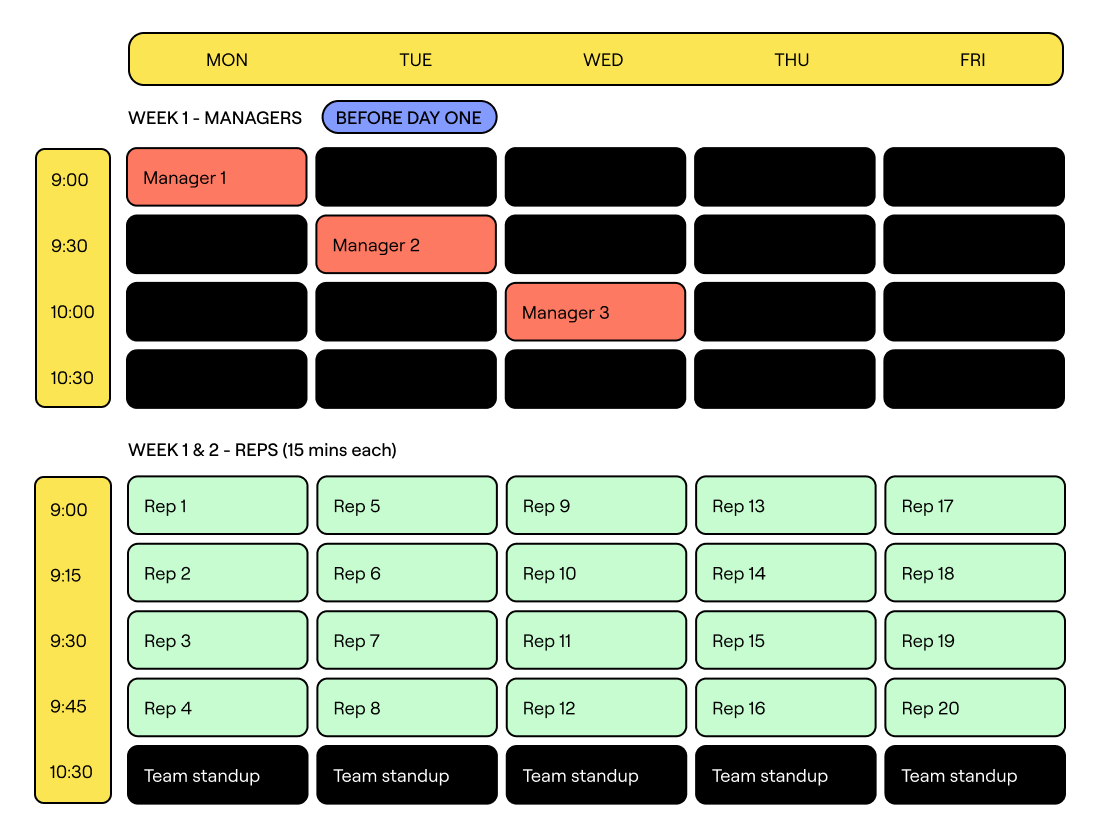
Before my first official day at Docebo, I booked time for phone calls with each of my managers to get a state of the union on the team.
I prefer “interviewing” my managers before talking to reps and I ask the same 4 questions to every leader:
- What's good, bad, and ugly on this team right now?
- How do you like to be challenged?
- What makes you feel like your week was worth it?
- How do you want to be recognized when you win? (Ex. Money, public recognition, private congrats from the CRO, etc)
From there, the first two weeks in the seat are for rep-level conversations to understand their POV on the sales org.
I schedule 15 minute blocks with every rep on the team and ask:
- What's working for you in the role today?
- What's getting in the way of your performance?
- What sucks about your role that you wish leadership would fix?
At this point, most leaders will have collected a laundry list of problems to fix and will start scrambling to knock as many as possible off their list.
That’s the wrong next step.
Before pouring your credibility and energy into making average reps slightly less average, you should actually turn your attention towards amplifying your top performers.
My first big efforts go towards scaling the greatness of my best reps so that my average performers can more easily model their behavior off them.
My simple workflow for scaling greatness:
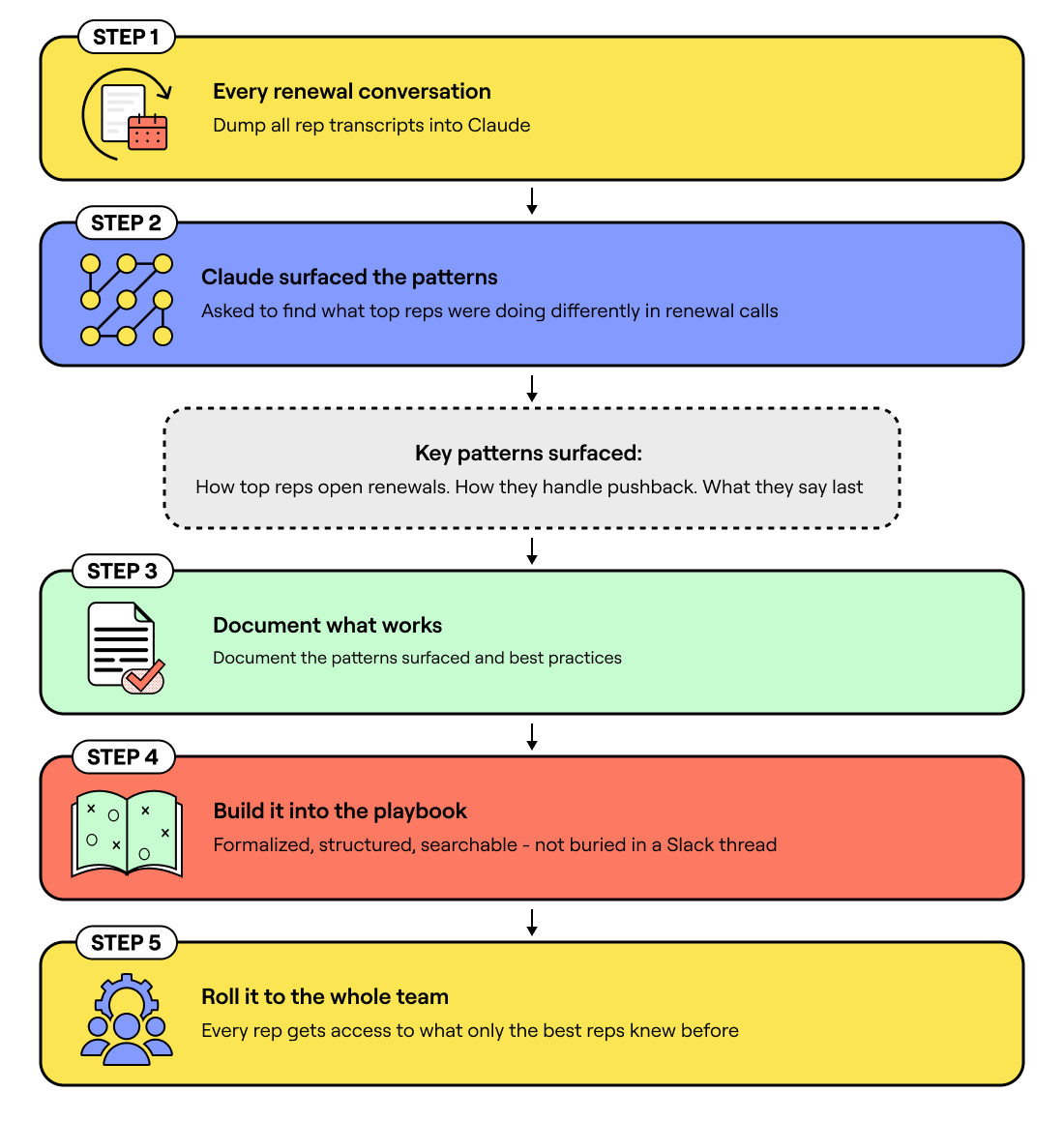
By day 30, you’ll have defined what great looks like, have it documented and started to roll it out to the team.
Now you can turn your attention to making other changes. Next up, I’ll cover how to make the highest impact changes with the lowest effort.
Days 30–60: High Impact, Low Effort Changes
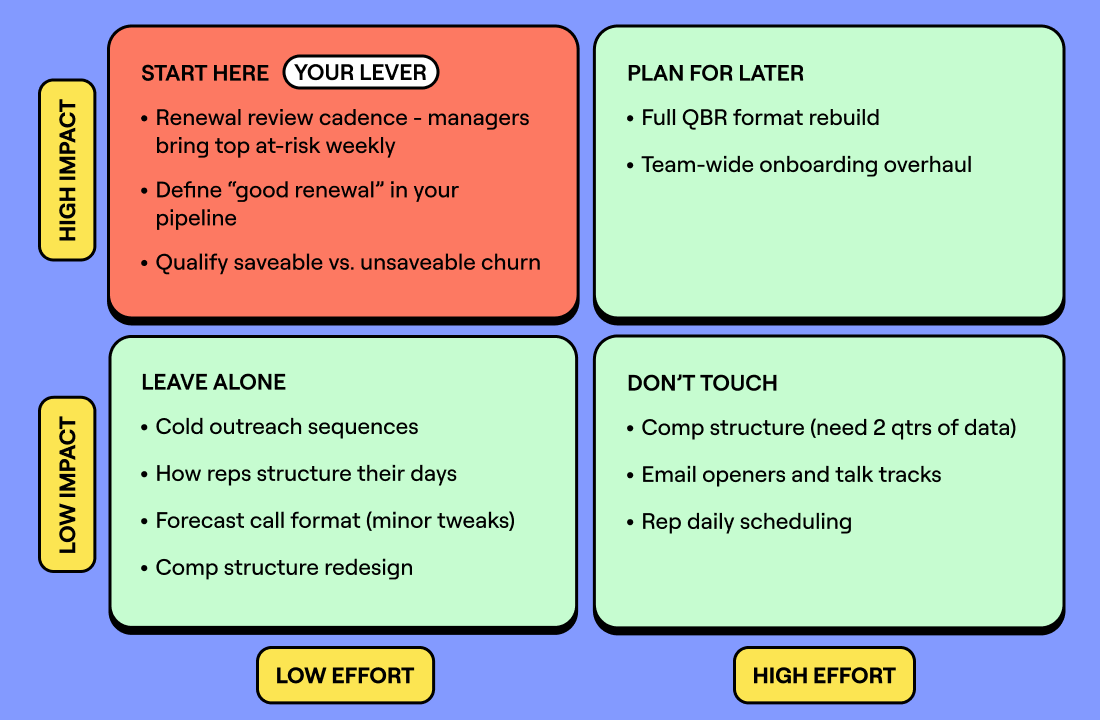
One of the hardest things for new sales leaders to accept is that you can’t fix everything right away.
As a leader, my focus was on high impact and low effort changes which meant accepting that small problems need to burn while I fixed the biggest leverage points.
In my first month at Docebo, I came to the conclusion that our churn number was the biggest lever for my team to focus on.
Like I said, I was not focused on spot fixing a few members that were struggling but rather focused on the process of the top performers.
The top-performing reps were:
- Starting their renewal process almost a year out from renewal date. This included business reviews, usage reports and value driven conversations to drive engagement.
- Multi-threading the account through several leadership stakeholders on both sides of the business.
- Flagging early renewal risk deals to their manager 6+ months out so we could take proactive action.
Once I knew what the best reps were doing, the next question was simple: how do I get the whole team doing the same thing?
So here is what I changed in the next 30 days:
- Asked managers to add a time block in their pipeline reviews to also discuss at-risk renewals
- Defined what a good renewal looked like so my reps could identify risk in their account:
- Are we multi-threaded with multiple use cases, or single-threaded with one?
- Is their team actively engaged with the platform or going dark?
- Are we proactively reaching out or just waiting for renewal to hit?
- Defined how to qualify saveable churn vs. unsaveable churn. This helped my team prioritize their time based upon business we could keep vs what was dead money.
Here are things I COULD have fixed, but left alone in favor of the biggest lever:
- Cold outreach sequences (Could always be tweaked; not going to impact churn)
- QBR format (I hadn’t seen a full quarter yet)
- Compensation structure (I needed two quarters of data minimum)
- How reps structure their days (I needed to earn more trust with the team before monkeying with their schedules)
We didn’t fix everything, but we did focus on the most important thing.
After you start to implement change, now you have to figure out if it’s working…before it actually works!
That’s what we’re covering in the next section.
Days 60–90: Is What I Changed Working?
As a leader, you're measured on lagging indicators (win rate, deal size, NRR). But those numbers take months to move, and you don't have the luxury of waiting.
So in the first 90 days, track leading indicators instead.
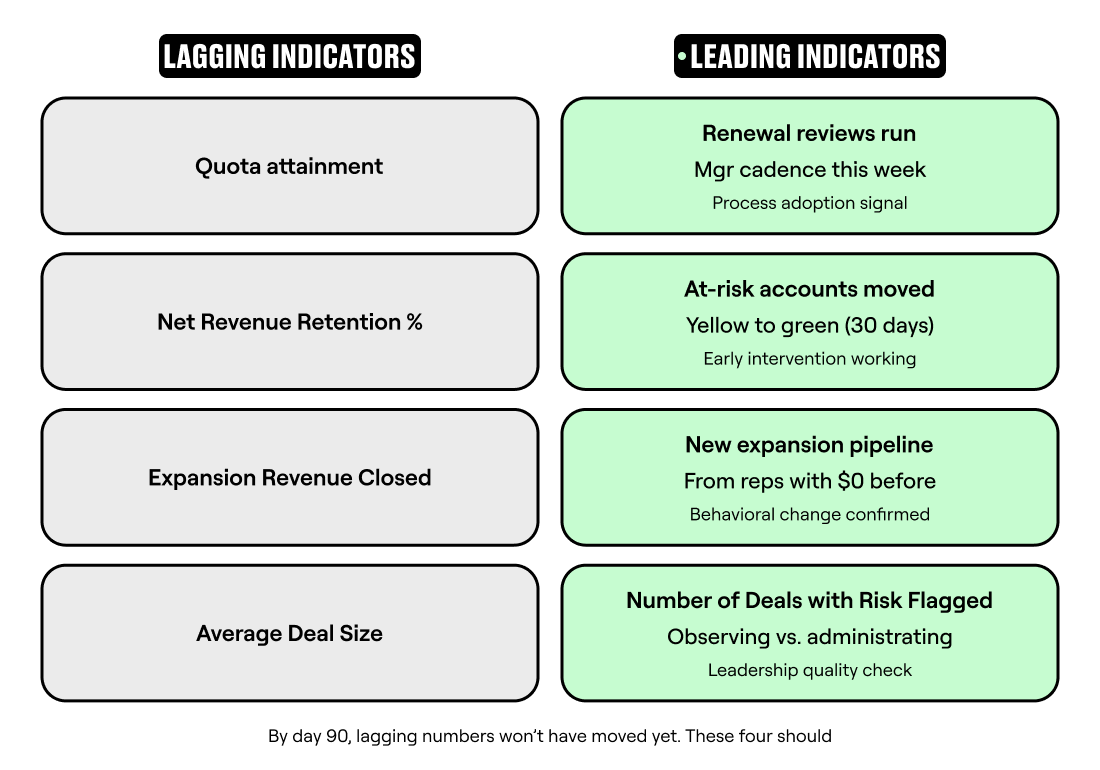
Leading Indicators I started tracking:
- Number of renewal reviews my managers ran each week to see if they were adopting the process change.
- At-risk accounts that moved from “risky to commit” in the last 30 days. This helped me see if early intervention was working.
- Expansion pipeline created by reps who weren't creating it before (behavioral change)
- Number of deals with risk flagged. I wanted to see this number increase in the first few weeks (increase in awareness around risk), and then start to decrease (increase in action to mitigate risk).
Communicating Upwards:
In your first quarter, your boss is probably anxiously wondering how things are going.
Don't make them wait for an update.
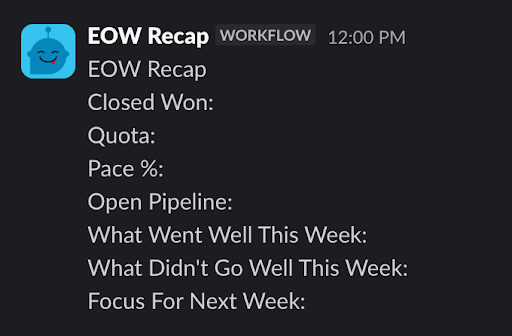
Every Friday, here’s what I send to my boss. It’s intentionally simple.
The first 90 days aren't about fixing everything.
They're about finding the right thing to fix, scaling what's already working, and building enough trust with your team that they'll follow you when the hard changes come.
Most new leaders spend their credibility in the first 30 days trying to prove they're doing something.
The ones who actually move the needle spend those same 30 days figuring out what's worth changing in the first place.
Get that right, and the results take care of themselves.
--
If you want to learn more about how you level up your personal and professional performance, follow me on LinkedIn or reach out to me for coaching at https://www.linkedin.com/in/seangentry/