

8x President’s Club winner Laura McDonald hit 305% of her number last year, and much of it was from her ability to win over stakeholders her competition never even got access to.
Today we’re breaking down Laura’s multithreading approach which includes sharing an imperfect org chart with her champion to identify who actually has influence and how to get access to those people.
We’ll be unpacking Laura’s plays across 3 key steps:
- Map the Org Chart to Establish the Power Base
- Convince Your Champion to Make Introductions
- Play Cupid: Match-Making Stakeholders
Let’s ride.
How Laura Maps the Org Chart to Establish the Power Base
Many AEs assume job titles indicate how much influence someone has so they waste hours tinkering with org charts in Sales Navigator to figure out who they should try multithreading with next.
The problem is, org charts lie. Sure, they show hierarchy, but actual influence doesn’t come with a title, it comes from the “power base”.
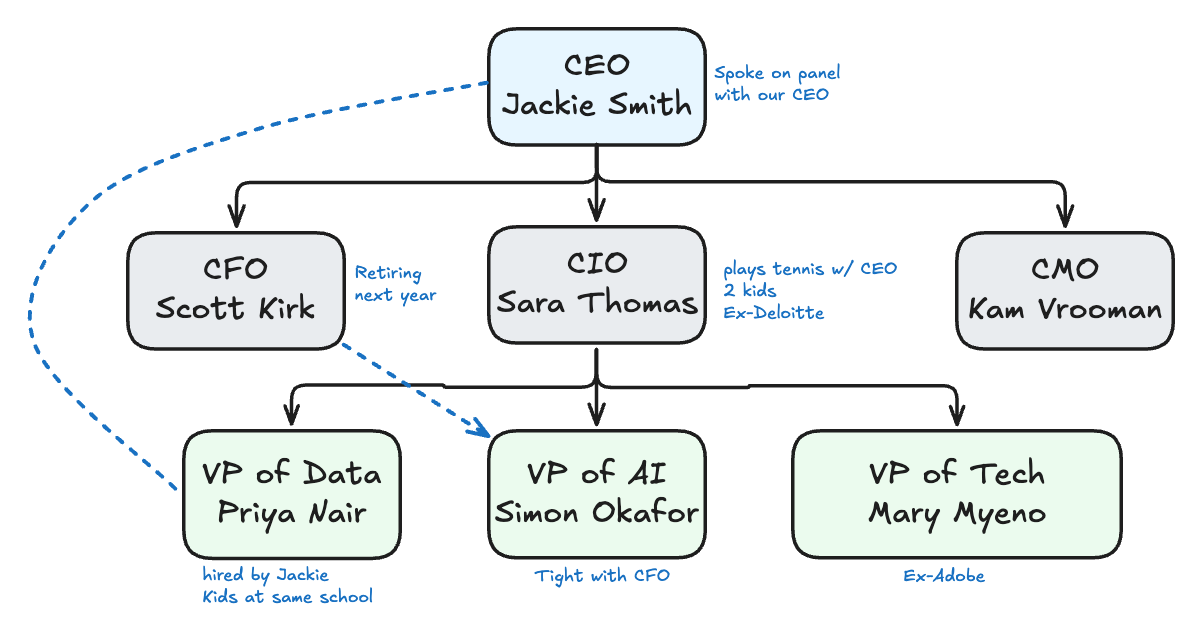
The power base is the group within the org chart that has real influence over buying decisions. So when Laura has some traction on a deal, she takes these 3 steps to map the power base:
- Whiteboard a rough draft of the org chart. Look at the example above, you only need: names, titles, and reporting lines. This doesn’t even have to be right - it should be right-ish, but giving your champion a few things to correct actually makes it easier to get them talking.
- Present the org chart to champion and ask 3 questions:
- “Are people in the right place?” → validate your chart
- “Do [Person A] & [Person B] get along?” → uncover internal politics and influence
- “Does [Person/Team] support this initiative?” → find your blockers/supporters
- Annotate the org chart with your champion live. Like the image above, add dotted lines and jot down notes in front of your champion to encourage them to continue sharing.
Once you know who you actually need to win over, now it's time to get access to those stakeholders.
How to Get Introductions From Your Champion

This conversation is meaningless gossip if you don’t use it to get access to the right people.
As you’re mapping the power base, when you find a stakeholder you need to get in front of, use these 3 tactics from Laura to get access to them:
1. Just ask. Be specific as to who, never just say “Who else do I need to meet here?”. If your Champion tells you Priya (VP of Data) was brought in by the CEO, ask your Champion for an introduction to Priya because she likely has influence.
But if you sense any hesitation…
2. Explain why it’s in their best interest.
“I’ve worked with VPs of Data at other Clients accounts before. Often the Data team’s needs are overlooked which can cause friction for you if they surface too late. I’d like to meet her to ensure we capture Priya’s requirements early, so they’re considered as the solution takes shape”
And if your Champion knows the other person doesn’t like talking to “sellers”...
3. Ask who they would take a meeting with. A VP of Data may not want to meet a salesperson, but they might be open to meeting a technical expert or one of your execs. Ask your Champion if they’re open to meeting with someone at your Org not in sales, and that’s your opportunity to play cupid.
Playing Cupid: Match-making Key Stakeholders
Don’t take it personally, but when your job title is AE not everyone wants to talk to you. Your prospect’s CXO or Lead Solution Architect may not want to meet anyone “selling” anything.
When this happens, “play cupid” to match-make your colleagues with other people at your prospect’s company.
The keys to Laura's match-making are:
- Make the right pairing. Match personality traits and styles. Your high-octane CRO probably isn't right for their introverted technical lead. Laura's go-to pairings:
- CXO ↔ Champion = shows them they’re important
- Technical ↔ Technical = let them geek out together!
- CXO ↔ CXO = status matching
- Existing Customer ↔ Champion = unbiased perspective
- Prepare your colleague. Share key details around the deal (e.g. firmographics, competitors, leverage, etc). Then make clear the ONE thing you need them to get/do in the conversation to help move the deal. This might be to get on a texting basis, to uncover where you actually stand relative to the competition, or to get a sense of how your pricing landed.
- Don’t let the love fizzle. Laura sets reminders for her colleagues to follow up with their “cupid match” to keep the relationship going after the initial meeting. It’s one thing to pair your CEO and their CEO once. It’s another to get your CEOs texting throughout the quarter.
There you have it. Take your status quo multithreading up a notch with these plays from a proven winner. Catch the full breakdown and more tactics from Laura in the video we did with her here.
That’s a wrap.