


1. The 90 Second Rule: Get Them to Sit Up
Most sales calls start behind the 8-ball in terms of mutual respect. Your prospect joins five minutes late, camera’s on but eyes clearly off to the side on Slack. They're only half listening to get the gist of your demo and hear the price.
A prospect decides whether they'll respect you within the first 90 seconds of the call, so use the 90 Second Rule to get them to sit up and actually listen to you by:
- Ditching the BS rapport.
Don’t say: "Happy Friday!"
Don’t say: "[Useless Comment on the Weather!]”
Don’t say: “So where are you calling in from?” - Show them you’re prepared and credible. Use one of these observation techniques:
Trigger Observation: Demonstrate that you prepared for the call while steering it toward something relevant to their business and your product.
Do say: “Holy smokes, you all just launched your new AI feature. How are people reacting?”
Astute Observation: Point out something you know about their business that most people don’t know.
Do say: “I read you're at 115% net retention, that's outstanding for a company of your size."
When their eyes shift back to the screen, you’ll know you have their attention. Now let them know why you’re here.
2. The Approach: Give Them Context
They know you did your homework, but they may still not remember why they took the call. Jump straight into discovery questions and they won't know what angle you're coming from, so their answers will be all over the place.
So give them the TLDR. The Approach is a 30-second elevator pitch that answers the three questions running through their head:
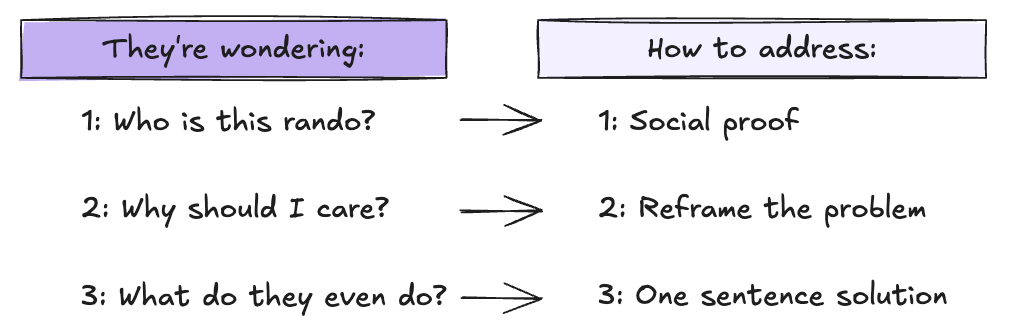
Here's how Armand runs it for our In-house Sales Trainer Service at 30MPC:
- Social proof example → “A lot of people know us as the #1 sales podcast. We've interviewed top trainers like Todd Caponi and Jen Allen, and we've got a ton of fans on your team.”
- Reframe the problem → “The reason we're talking is that a lot of sales leaders tell us most trainers show up, deliver theoretical training and disappear after 2 days. That creates more work for your enablement team, and nothing actually changes.”
- One-sentence solution → "We train your team on everything from cold calling to negotiation, AND we stay on to help build the playbooks and run reinforcement.”
Pro tip: This is also your moment to fix misconceptions. If you're known for background checks but you actually sell a full HR suite, say so now, before they answer every question as if you only do background checks.
Time check, you should only be about 2 min into the call, so tell them what the next 28 min look like.
3. PPO Agenda: Set Clear Expectations
If you don’t set a discovery call agenda, your prospects' eyes will go right back to Slack noise and they’ll only tune back in for two parts: the demo and the price.
Avoid this by setting clear expectations for the meeting.
Use the Purpose, Plan, Outcome (PPO) Agenda to not only set the sales agenda, but also show your prospect you’re organized and know how to lead a conversation, which leads to even more credibility.
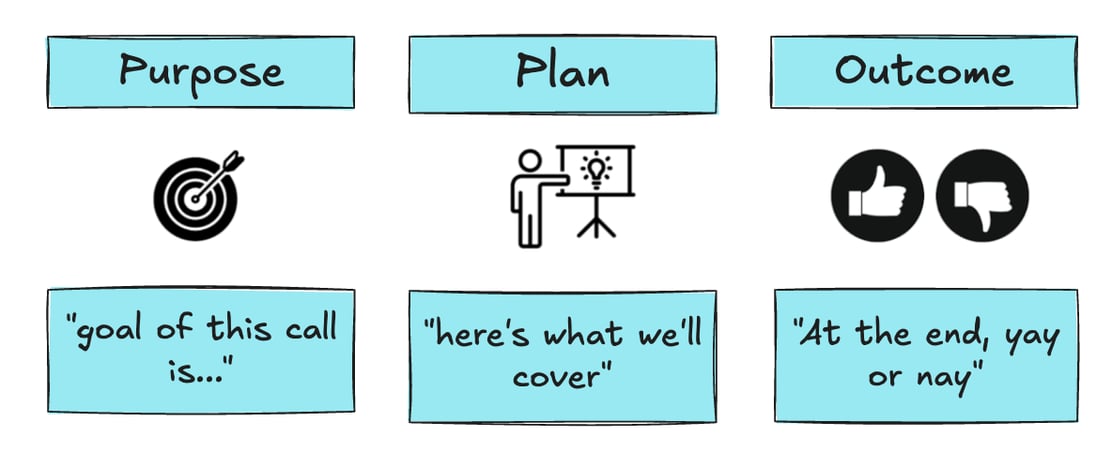
Purpose: Show them this call will not be a product dump, but rather an opportunity to see if there is a problem that your solution can solve.
“The purpose of this call is to get a sense of your priorities and explore if there’s any opportunity for us to improve your current CRM tool."
Plan: Share the topics you’ll cover to achieve the purpose, and set the expectation that you need a deeper understanding of their business to show them a relevant demo.
“So I’d love to learn more about how you’re using your CRM today and share a bit about where we can be most helpful, and reserve the last 5 minutes to show you a brief overview of how our CRM works.”
Outcome: Be clear on the goal attached to this call so that the prospect knows exactly what you are driving towards with your questions, and the decision that they will be faced with at the end:
“And by the end, I’d love to have an honest convo on whether or not you feel like we could be a fit. Is there anything else you wanted to get out of this one?”
Ending with this question allows your prospect to opt in to the plan you laid out for the rest of the call. When prospects know what to expect, they can focus on the conversation.
Initial credibility officially earned. Of course you have to keep building on it, but you’re only a couple minutes in and for now you've got the right to start PT on your prospect's problem.
That's a wrap!