Published by 30 Minutes to President's Club with Nooks Last updated

Key Takeaways

  • A sales signal is an event, change, or trigger at a company that creates urgency around a problem your product solves. It gives you a legitimate reason to reach out.
  • Relevance has a formula: Signal + Problem + Cost of Inaction = Relevance. The signal is why you reach out; the problem statement connects the dots.
  • The best places to find signals are LinkedIn Sales Navigator alerts, G2 reviews, company websites, job postings, Glassdoor reviews, 10-K filings and earnings calls, and industry news.
  • A cold call that converts follows four steps: pattern interrupt opener, trigger reference, problem validation, then a soft CTA.
  • The Relevant Observation cold email has four parts: a relevant observation, the problem or cost, a short educate line with social proof, and one low-friction CTA.
  • A 5-day multi-channel sequence combines LinkedIn, email, and phone: triple touch, LinkedIn engagement, a bump email, a second call plus LinkedIn connect, and a breakup email.
  • Nooks' parallel dialer lets reps skip voicemails, auto-log notes, and have 2-3x more live conversations per session.
Intro

Here’s the problem.

Every rep has AI now. Every rep has a sequencer. Every rep can send 500 emails a week.

So your prospect’s inbox looks exactly like it did last year, except there are twice as many emails in it and every single one of them sounds like it was written by the same robot.

The reps winning right now are not the ones sending more.

They’re the ones sending something that lands because it references something actually real, delivered at the right moment, across the right channels, with persistent follow-up touchpoints.

So today I’m gonna teach you how to get replies even in the noisy world of AI:

  1. 1

    Finding the Signal: How to identify the signal that gives you a real reason to reach out, where to find it, and how to connect it to a problem that makes your prospect sit up and pay attention.

  2. 2

    The Template: The exact cold call framework and cold email structure that turns your signal into a booked meeting, including a real example email you can steal today.

  3. 3

    The Nurture Drip: A 5-day multi-channel sequence you can plug in right now, plus the mindset shift that separates reps who follow up smart from reps who just follow up a lot.

This toolkit was put together with our friends at Nooks who make all of the above way, way easier.

Along the way you’ll see how their AI dialer, parallel calling, AI sequencing, and signal engine help you break into your top accounts without spending hours and hours rewriting the same emails, listening to dial tones, or dealing with “meh” prospects.

Section 1

Finding the Signal

The real unlock in outbound is finding the signal that gives you a legitimate reason to reach out with a relevant message.

Definition

A signal is the event, change, or other trigger at a company that creates urgency around a problem your product solves.

Without it, you are just another rep in the inbox or a random call on a Tuesday.

Examples of signals include:

  • a company just raised funding
  • they posted 4 new SDR job openings
  • their CEO was quoted in an article about scaling outbound
  • they launched a new product line
  • leadership changes
  • G2 reviews mentioning pain in an area you solve
  • earnings call commentary about pipeline challenges
  • tech stack changes visible on job postings

Now, here is where the best reps are finding signals:

  • LinkedIn Sales Navigator saved searches and alerts(job changes, company growth, posted content)
  • G2 reviews and competitor comparison pages(prospects publicly venting about pain points)
  • Websitekey customers, product launches, multi-product, SLG vs PLG, etc
  • Job postings on their careers page(hiring signals tell you what they are investing in)
  • Glassdoor employee reviews(operational pain from the inside)
  • 10-K filings and earnings calls(public companies telegraph priorities)
  • Industry news, podcast appearances, conference speaker lists

From there, the key is connecting the signal to a problem (this is where most reps drop the ball). They find a signal but never connect it to a problem.

The signal is the reason you reach out. The problem statement is what connects the dots.

When paired together, you get a response.

The formula: Signal + Problem + Cost of Inaction = Relevance.

Nooks · Signal engineSee it →
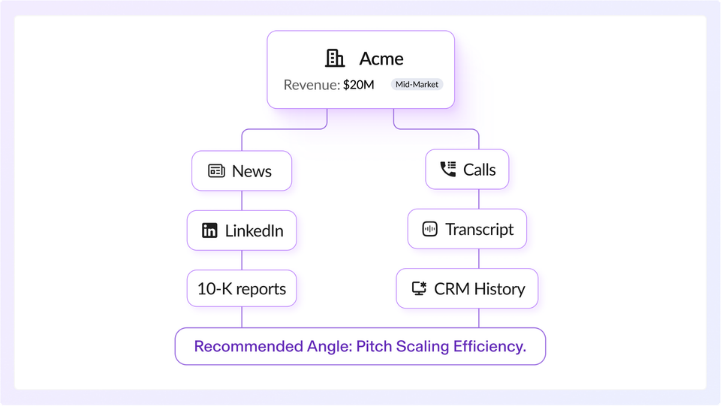
Nooks signal engine screenshotNooks research tree for Acme: news, LinkedIn and 10-K signals plus calls, transcripts and CRM history roll up into a recommended angle, Pitch Scaling Efficiency
Where Nooks helps

Nooks AI agents take the pain out of manually hunting for signals by monitoring your accounts in the background and pulling signals from your CRM, call transcripts, and the web.

The signal engine surfaces buying signals and account changes in real time, so reps know exactly where to focus and why. Instead of burning time on manual research before every call, Nooks hands you the signal on a silver platter.
Section 2

The Template

Once you have the signal, you need a framework for how to actually deliver the message. Not a rigid script. A framework you can adapt to every conversation and every email. Here is what works.

The cold call script framework

Forget the 30-second pitch. Your cold call should be a conversation, not a monologue. Here is the flow:

  1. 1

    Pattern interrupt opener

    “Hey [name], this is a cold call, but I can assure you it’s a well researched one. Mind if I share why I am calling you specifically and you can let me know if it’s relevant or not?”

  2. 2

    Trigger reference

    “The reason I am calling is I saw [signal]. When I see that, it usually means [problem].”

  3. 3

    Problem validation

    “Was curious to learn how you’re tackling that”

  4. 4

    Soft CTA (after problem validation)

    “Would it make sense to grab 15 minutes later this week so I can show you how [competitor] handled the same thing?”

    → Low friction. Specific. Easy to say yes to.

From there transition to the pitch:

The reason I'm reaching out is I noticed you just posted [X] new SDR/BDR roles on your careers page

[pick one]:

The Problem: When I talk to sales leaders scaling outbound teams that fast, the two things that usually break first are rep productivity and connect rates. Reps end up spending half their day toggling between their dialer, their sequencer, and three different data tools instead of actually talking to prospects. And the more reps you add, the worse that problem compounds.

How are you ramping your new reps right now?

The cold email framework

I call this the Relevant Observation framework. Every cold email that has ever booked me a meeting followed this structure:

Click a part to highlight it in the example email.

Here’s an example email:

Subject: ramping reps

Saw you just posted 3 new BDR roles and your team grew 40% in the last quarter, Name.

Typically when teams scale that fast, reps usually end up spending more time toggling between onboarding notes, tools and doing manual research than actually having productive conversations with prospects.

[Company] just switched to Nooks as they scaled their team from 5 to 40 BDRs and were able to have reps booking meetings within 2 weeks of their start date.

Worth taking a look at how?

Remember, the best cold emails:

  1. Are relevant to the prospect
  2. Read like an internal email
  3. Use indifferent tonality
  4. Don’t make assumptions
  5. Educate the reader
  6. Leave them wondering & wanting more

And the beauty of starting with the signal is you find the signal once and then use it again and again in your LinkedIn messages, cold call opener, and the first line of your email.

There is no single best channel. The key is to get them with the messaging over and over on multiple channels, and buyers will respond in the channel that they use most commonly. That’s not for you to decide!

Nooks · AI draftingSee it →
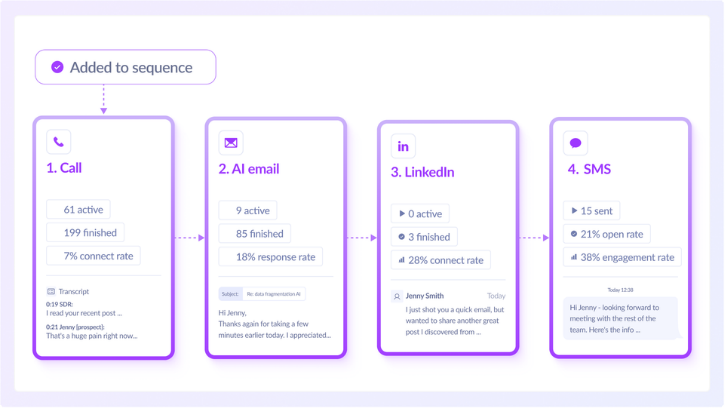
Nooks AI drafting screenshotNooks multi-channel sequence: call, AI email, LinkedIn and SMS steps with transcript snippets, drafted messages and engagement rates
Where Nooks helps

And Nooks AI agents make this even easier by automatically writing emails, using context from your CRM, prior call transcripts, and real-time buying signals — with hallucination guardrails so reps can trust what goes out.

On the calling side, Nooks can even generate AI-powered call scripts and battlecards before every dial, and the parallel dialer lets reps skip voicemails, auto-log notes, and have 2-3x more live conversations per session.

Section 3

The Nurture Drip

Most reps send one email, make one call, and move on… Or they let their overdue tasks pile up. Here is a 5-day multi-channel sequence you can steal and start using today.

Point 1: The 5-Day Mini Multi-Channel Sequence

Day 1: The Triple Touch

  • Morning: View their LinkedIn profile (puts your face to a name before they see your email)
  • Mid-morning: Send Email #1 using the Relevant Observation framework above (signal + problem + CTA)
  • Afternoon: Call and reference the email you just sent (“Hey, I just shot you a note about [signal]. No need to call me back but [competitor] is solving this with Nooks and wanted to share how you could do the same based on [problem].”). Prospects will read the voicemail transcription

Day 2: Engage on LinkedIn

  • Leave a genuine, thoughtful comment on one of their recent LinkedIn posts (not "great post!" but actually add to the conversation)
  • If no content to engage with, view their profile with your privacy on ‘public’

Day 3: Email #2 (The Value Add)

  • Bump email 2
  • “Given (signal), any thoughts on the above?”

Day 4: Call #2 & LinkedIn Connect

  • Call again. Reference the resource you sent. "Hey [name], I sent over that [resource] yesterday. Quick question for you..." then ask one problem-validation question.
  • If no answer, leave a voicemail. Keep it under 20 seconds. Name, company, one sentence on why you called, your number.
  • LinkedIn Connect: “Hey [name], sent you a couple of emails, just wanted to put a face to the name”

Day 5: The Breakup

  • Email #3: Short, direct, no guilt trip. "Hey [name], I have reached out a few times and have not heard back, so I will assume the timing is off. If tackling [problem] based on [signal] ever becomes a priority, I am an easy person to find. Either way, good luck with [specific initiative you referenced]."
  • This works because it is respectful, references something specific, and keeps the door open without being desperate.

Point 2: Why multi-channel matters more than ever

In a world where every rep has access to the same AI email tools, the phone and LinkedIn are your differentiators. Your prospect is not sitting around waiting for your email. They are in back-to-back meetings, scanning 100+ messages, and making split-second decisions about what deserves their attention.

Point 3: Track, learn, and iterate

Monitor your email engagement (opens, clicks, replies) and use that data to adjust your sequence in real time. If someone opens your email three times but does not reply, move the call up. If your Day 1 email gets zero traction, test a new subject line or lead with a different signal. The sequence is a framework, not a set-it-and-forget-it automation. The best reps are constantly tweaking based on what the data tells them. They act like the QB of the sequence and make adjustments on the fly.

Nooks · AI sequencingSee it →
Where Nooks helps

Nooks consolidates dialing, sequencing, and social touches into one workspace so reps are not toggling between 5 different tools to run a multi-channel cadence. AI Sequencing dynamically prioritizes high-intent accounts and personalizes every touchpoint based on real-time buyer behavior.

The AI Dialer handles parallel dialing, automatically drops voicemails, logs your calls and more so reps can focus on the conversation, not the admin. And because everything lives in one platform, managers can see exactly what is working and coach accordingly.

Final thoughts

That’s a wrap folks!

In today's day of AI, you have to be hyper-relevant, but the problem is that being relevant takes time.

That's where Nooks comes in. Here’s how they help you break through the noise:

  1. They help you identify the signals without hunting for them manually
  2. Then draft the emails and even generate your call scripts
  3. And cover every single touch point beyond the phones, across email and multi-channel prospecting
Go check them out →
30MPC ×
FAQ

Frequently Asked Questions

What is a sales signal in outbound prospecting?

A sales signal is an event, change, or trigger at a company that creates urgency around a problem your product solves, such as a funding round, new SDR job postings, leadership changes, or a new product launch. It gives you a legitimate reason to reach out with a relevant message.

Where can sales reps find buying signals?

Top reps find signals in LinkedIn Sales Navigator saved searches and alerts, G2 reviews and competitor comparison pages, company websites, job postings, Glassdoor employee reviews, 10-K filings and earnings calls, and industry news, podcast appearances, and conference speaker lists.

How do you turn a signal into a relevant message?

Connect the signal to a problem it likely creates, then add the cost of inaction. The formula is Signal + Problem + Cost of Inaction = Relevance. The signal is the reason you reach out, and the problem statement is what connects the dots.

How should you open a cold call?

Use a four-step flow: a pattern interrupt opener ("this is a cold call, but I can assure you it’s a well researched one"), a trigger reference to the signal you saw, a problem validation question, and a soft CTA asking for 15 minutes later in the week.

What is the best cold email framework for getting replies?

The Relevant Observation framework has four parts: open with a relevant observation (the signal), connect it to a problem or cost, briefly educate with social proof from similar companies, and close with one low-friction question like "is this even on your radar right now?"

What does a good 5-day multi-channel follow-up sequence look like?

Day 1: view their LinkedIn profile, send an email, and call referencing it. Day 2: comment on their LinkedIn post. Day 3: send a bump email. Day 4: call again and send a LinkedIn connection request. Day 5: send a short, respectful breakup email.

How does Nooks help reps improve response rates?

Nooks AI agents monitor accounts for buying signals from your CRM, call transcripts, and the web, draft emails and call scripts using that context, and run dialing, sequencing, and social touches in one workspace. Its parallel dialer lets reps skip voicemails, auto-log notes, and have 2-3x more live conversations per session.